Which e-learning platform is best for your goals in 2025?
 Dec, 4 2025
There are hundreds of e-learning platforms out there. But asking which one is "best" is like asking which car is best-depends on what you need to drive, where you’re going, and how much you’re willing to pay. If you’re trying to land a job in data science, get certified in project management, or just learn Spanish for fun, the answer changes every time. So let’s cut through the noise and find the real winners based on what actually works in 2025.
What do you actually want to learn?
The first mistake people make is picking a platform based on popularity. Coursera has Harvard courses. Udemy has 200,000 classes. edX is backed by MIT. But none of that matters if the content doesn’t match your goal.
Are you looking for a recognized credential that employers trust? Then Coursera and edX are your top choices. They partner with universities and offer degrees, professional certificates, and even micro-masters. Google and IBM certifications on Coursera are listed on resumes and accepted by hiring managers across North America.
Want to pick up a new skill fast-like Excel, Canva, or Python-without worrying about diplomas? Udemy wins here. Courses are often under $20, updated frequently, and taught by industry practitioners. No accreditation, but you’ll be doing real work by week three.
Learning a language? Duolingo is great for daily practice, but if you want real fluency, try italki or Preply. These connect you with native speakers for live tutoring. One 30-minute session with a certified French tutor on italki costs less than a coffee, and you’ll speak better than after six months of an app.
Cost matters more than you think
Free platforms sound great-until you hit a paywall for quizzes, certificates, or graded assignments. Coursera offers free access to course content, but you pay $49-$99 to get the certificate. Udemy rarely charges more than $15 for a single course, especially during sales. LinkedIn Learning gives you full access with a $30/month subscription, but only if you’re already using LinkedIn for job hunting.
Here’s the reality: most people don’t finish free courses. The completion rate for free MOOCs is under 10%. Paying even $10 makes you more likely to finish. You invest time because you invested money. That’s psychology, not just pricing.
For students or professionals on a tight budget, platforms like Khan Academy and MIT OpenCourseWare are completely free and high quality. They won’t give you a certificate, but they’ll teach you calculus, physics, or economics better than most university lectures.
Structure and support: Are you learning alone or with help?
Some people thrive on self-paced learning. Others need deadlines, feedback, and community. If you’re the type who skips assignments, gets stuck on a concept, and gives up-then structure is everything.
Coursera and edX offer weekly deadlines, peer-reviewed assignments, and discussion forums with thousands of learners. Some courses even have live Q&A sessions with instructors. That accountability keeps you on track.
Udemy? You download the videos, watch them on your own schedule, and that’s it. No reminders. No interaction. If you’re disciplined, fine. If you need a coach, you’ll feel lost.
For hands-on learners, platforms like Codecademy and DataCamp are built for doing, not just watching. You write code in the browser, get instant feedback, and move to the next challenge. It’s like learning to ride a bike with training wheels-no theory, just practice.
Industry recognition: Will this help you get hired?
Employers in tech, finance, and marketing don’t care if you finished a course on Udemy. They care if you have a certificate from a trusted source.
Here’s what hiring managers actually look for in 2025:
- Google Career Certificates (Data Analytics, UX Design, IT Support) on Coursera
- Microsoft Learn certifications (Azure, Power BI)
- IBM Data Science Professional Certificate
- Project Management Professional (PMP) prep via Coursera or edX
- LinkedIn Learning paths endorsed by industry leaders
These aren’t just badges. They’re signals. When you list a Google Career Certificate on your resume, your application gets flagged by ATS systems. That’s real advantage.
Udemy certificates? They’re nice to have. But they’re not trusted by HR departments. They’re proof you bought something-not that you mastered it.

Mobile and offline access: Can you learn on the go?
Life doesn’t wait for you to sit at a desk. You commute. You wait in line. You’re on a lunch break. The best platforms let you learn anywhere.
Coursera and edX have full mobile apps with offline downloads. You can watch lectures on the subway without Wi-Fi. Udemy does the same. Duolingo is built for 5-minute sessions. Even LinkedIn Learning lets you download videos for offline viewing.
But not all platforms are equal. Some smaller ones have clunky apps, slow loading, or no offline mode. If you’re relying on your phone, test the app before you pay.
Specialized needs: What if you’re learning to code or become a designer?
General platforms are great, but some fields need specialized tools.
For coding: Codecademy is beginner-friendly. freeCodeCamp is 100% free and builds real projects. Pluralsight is better for advanced developers needing deep dives into cloud infrastructure or DevOps.
For design: Domestika offers creative courses in illustration, branding, and motion graphics taught by working professionals. Skillshare has a huge library but lacks structure. You’ll need to curate your own learning path.
For business and leadership: Harvard Business School Online offers real HBS cases and simulations. It’s expensive ($2,000+), but if you’re aiming for a promotion, it’s worth it.
What most people miss: The hidden cost of time
Time is your real currency. A $10 course that takes 40 hours to finish costs you $0.25/hour. A $100 course that takes 10 hours? That’s $10/hour. But if you’re spending 60 hours on a course you don’t finish, it’s free and worthless.
Here’s the rule: pick platforms that match your available time. If you only have 5 hours a week, choose short, focused courses. If you have 15 hours, go for a 3-month specialization.
Also, avoid platforms that overload you with content. More courses ≠ better learning. One well-structured path beats ten scattered modules.
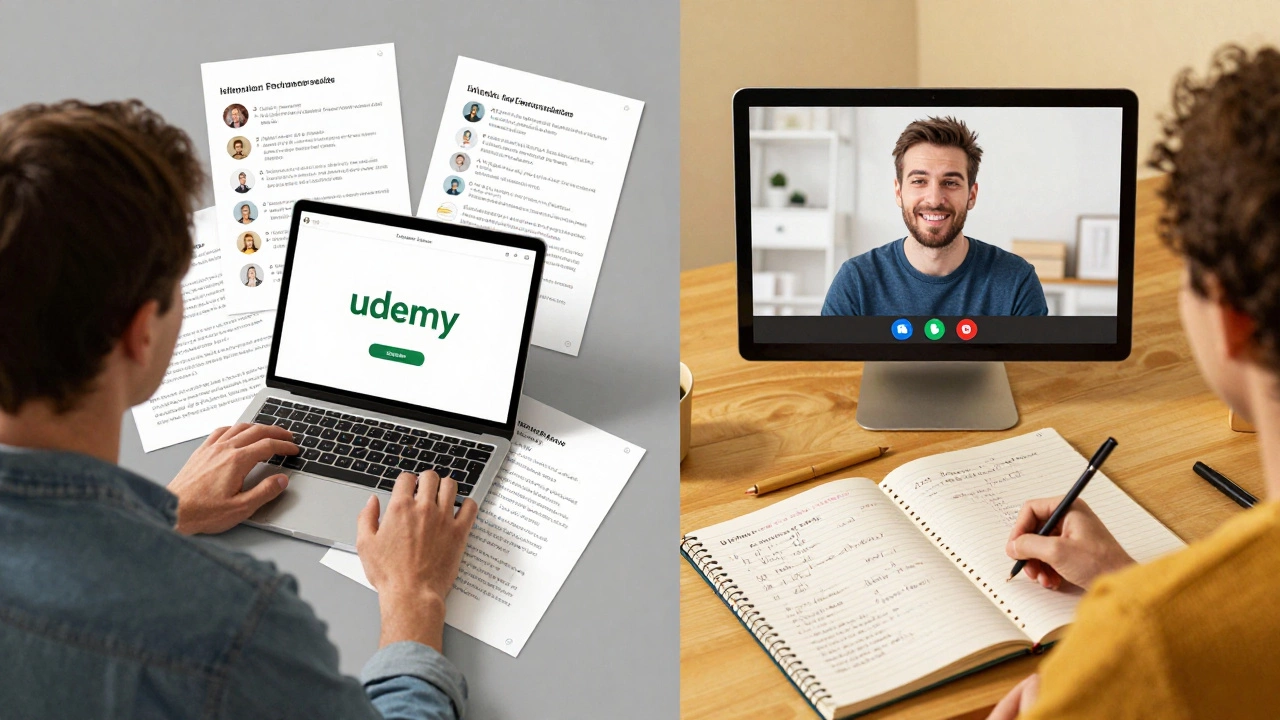
Final verdict: Who wins in 2025?
There’s no single "best" platform. But here’s who wins for each use case:
- For jobs and certifications: Coursera and edX
- For affordable, quick skills: Udemy
- For coding and tech: Codecademy or freeCodeCamp
- For languages: italki or Preply
- For creative skills: Domestika
- For free, high-quality academics: Khan Academy and MIT OpenCourseWare
Most people should start with one platform and stick with it for 3-6 months. Switching too often means you never build momentum. Pick based on your goal, not the hype.
What to do next
Don’t sign up for everything. Pick one goal. Pick one platform. Start today.
If you want a job in data analysis: enroll in the Google Data Analytics Certificate on Coursera. It’s $49/month. You’ll finish in 6 months. You’ll have a portfolio. You’ll be qualified.
If you want to learn graphic design: buy one $15 course on Udemy on Adobe Illustrator. Watch it. Do the project. Repeat. That’s how skills stick.
You don’t need the best platform. You need the right one-for you, right now.
Is Coursera better than Udemy?
It depends. Coursera is better if you want university-backed certificates that employers recognize. Udemy is better if you want cheap, practical skills you can learn quickly. Coursera courses are structured like college classes. Udemy is more like watching YouTube tutorials-with quizzes. Neither is "better." Choose based on your goal.
Are free e-learning platforms any good?
Yes, but with limits. Khan Academy and MIT OpenCourseWare offer world-class content for free. You won’t get a certificate, and there’s no interaction. But if you’re learning for knowledge-not a job-these are unbeatable. For career-focused learning, paid platforms with credentials give you a real edge.
Can I trust Udemy certificates on my resume?
You can list them, but don’t expect them to open doors. Most HR systems don’t recognize Udemy certificates. They’re not accredited. But if you mention a project you built using skills from a Udemy course-like "Built a portfolio website using Python and Flask after completing a 12-hour course"-that’s valuable. The certificate doesn’t matter. The skill does.
What’s the best platform for learning programming?
For beginners: Codecademy or freeCodeCamp. Both let you code in the browser with instant feedback. For intermediate learners: Pluralsight or Udemy for deep dives into frameworks like React or Django. For those aiming for jobs: complete freeCodeCamp’s full-stack certification-it’s free, respected, and includes real-world projects.
Do I need to pay for a subscription or can I buy single courses?
You can do both. Platforms like Udemy and Domestika sell individual courses. Coursera and LinkedIn Learning offer subscriptions. If you plan to take 3+ courses in 6 months, a subscription saves money. If you’re just learning one skill, buy the course. Don’t pay monthly unless you’ll use it regularly.
Common mistakes to avoid
- Signing up for too many platforms at once
- Choosing based on flashy ads, not course reviews
- Ignoring completion rates and instructor credentials
- Not checking if certificates are recognized in your industry
- Waiting for the "perfect" platform instead of starting now
The best e-learning platform is the one you actually use. Start small. Stay consistent. Build skills, not collections of unfinished courses.