What Is the Best Time to Read for Competitive Exams?
 Mar, 10 2026
There’s no magic hour that works for everyone, but the best time to read for competitive exams isn’t random-it’s tied to your body’s natural rhythms, your daily routine, and how your brain processes information. If you’re cramming at midnight because you think "more hours = better results," you’re likely wasting energy. The real secret isn’t how long you study-it’s when you study.
Your Brain Has a Daily Performance Curve
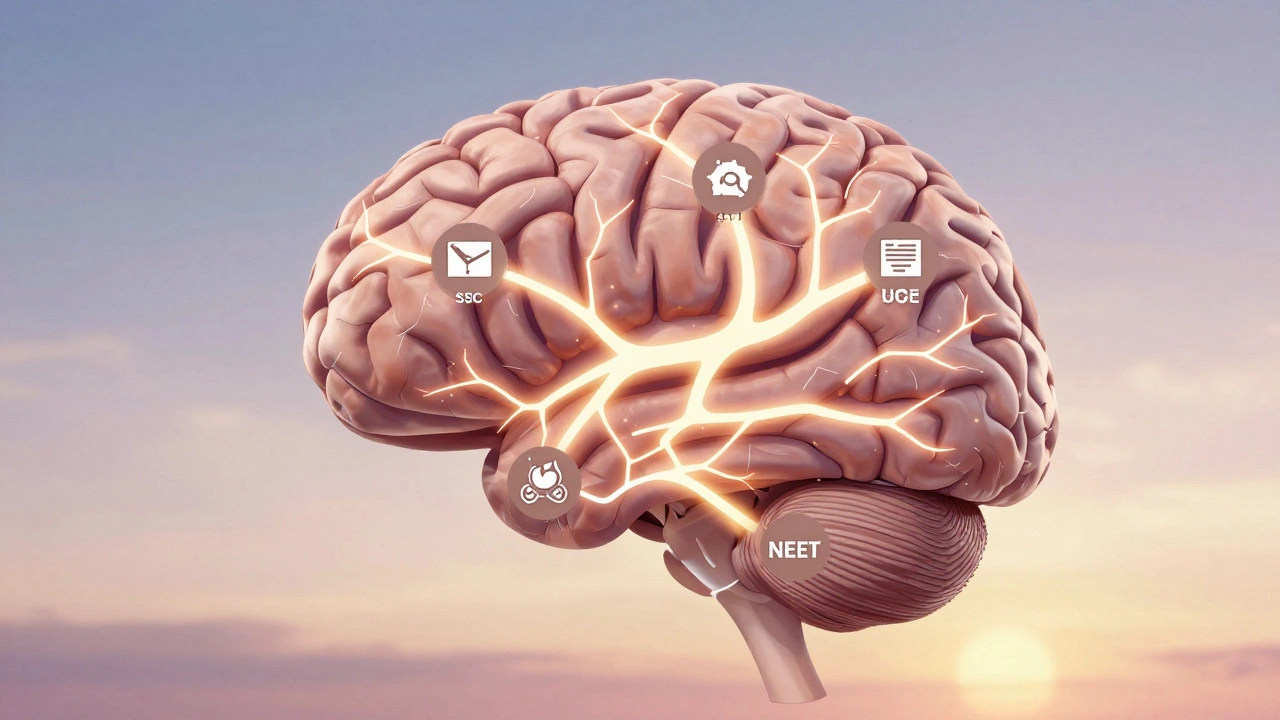
Your brain isn’t equally sharp all day. Studies from the University of Toronto and the National Institute of Mental Health show that most people hit their cognitive peak between 9 a.m. and 11 a.m. That’s when memory retention, logical reasoning, and focus are at their highest. For competitive exams like UPSC, SSC, GRE, or GMAT, this window is gold. This is when your prefrontal cortex-the part responsible for complex decision-making-is fully awake and firing on all cylinders.If you’re a morning person, use this time to tackle tough subjects like quantitative reasoning, data interpretation, or legal reasoning. These require deep concentration. Save lighter tasks-vocabulary, current affairs, or revision-for later in the day.
Why Midnight Studying Often Backfires
You’ve probably heard someone say, "I study best at night." Maybe you’re one of them. But here’s the catch: studying past 1 a.m. doesn’t mean you’re being disciplined-it means you’re sacrificing sleep quality. Sleep isn’t downtime. It’s when your brain consolidates what you learned. Skimp on sleep, and you forget more than you retain.A 2023 study from the University of California tracked 2,100 students preparing for national competitive exams. Those who studied between 7 a.m. and 10 a.m. and slept 7-8 hours scored 23% higher on retention tests than those who studied after midnight, even if the latter group logged 3 extra hours. The difference wasn’t effort-it was recovery.
Best Time by Exam Type
Not all exams are the same. The ideal study time shifts depending on what you’re preparing for.- UPSC / Civil Services: Focus on morning hours (8 a.m.-11 a.m.) for GS papers and essay writing. These require long-form thinking and structured expression. Use 4-6 p.m. for current affairs reading-your brain is still alert but less fatigued.
- SSC CGL / Bank Exams: These are speed-based. Train your brain for quick recall between 10 a.m. and 1 p.m. Practice mock tests in this window to simulate exam conditions.
- GRE / GMAT: Verbal and analytical sections peak in focus between 9 a.m. and noon. Save quantitative practice for late afternoon (3-5 p.m.), when your working memory is still strong but less pressured.
- NEET / AIIMS: Biology memorization works best in the morning. Use 7-9 a.m. for diagrams and NCERT revision. Save chemistry and physics problem-solving for 3-5 p.m., when your brain handles abstract logic better.
How to Find Your Personal Peak
Not everyone is a morning person. Some people are night owls. That’s fine-but even night owls need to align with exam timing. If your exam starts at 10 a.m., you need to train your brain to perform then.Here’s a simple 7-day test:
- For three days, study from 7 a.m. to 10 a.m. Track how many questions you get right and how tired you feel.
- For three days, study from 7 p.m. to 10 p.m. Do the same tracking.
- On day seven, take a full mock test at 10 a.m. (same as real exam time).
Compare your scores and energy levels. You’ll see patterns. Maybe your brain zips through math at 8 p.m., but you blank on reading comprehension. That’s your data. Adjust your schedule around it.
Consistency Beats Timing
Even the best time won’t help if you’re inconsistent. Studying at 8 a.m. every day trains your brain to expect focus at that hour. It’s like conditioning a reflex. Your body starts releasing focus chemicals-dopamine, norepinephrine-automatically when the clock hits 8.One UPSC topper from Delhi shared in a 2025 interview: "I never studied past 11 p.m. I woke up at 5:30 a.m. every day, even on weekends. By the third month, my brain would wake up before my alarm. That’s when I knew I’d built the rhythm."
What About Breaks and Environment?
Timing matters, but so does context. Your study space should be quiet, well-lit, and free of distractions. No phone. No TikTok. No background music with lyrics. Research from MIT shows that ambient noise (like white noise or soft instrumental music) can help, but vocal music reduces reading comprehension by up to 40%.Take a 5-10 minute break every 60 minutes. Walk around. Look out the window. Hydrate. Your brain needs micro-recovery. Don’t just scroll through Instagram-that’s not rest. True rest means changing your sensory input.
Final Rule: Match Your Study Time to Your Exam Time
This is the most overlooked tip. If your exam is at 2 p.m., you should be doing your heaviest studying between 1 p.m. and 3 p.m. Why? Because your brain needs to learn to perform under those exact conditions. You’re not just memorizing facts-you’re training your mind to be alert at a specific time of day.Think of it like an athlete. A sprinter doesn’t train at 6 p.m. if the race is at 9 a.m. They adjust. So should you.
Start tomorrow. Set your alarm 30 minutes earlier. Sit at your desk with your books. No phone. Just you and the material. Do this for five days. You’ll notice a shift-not just in how much you remember, but in how confident you feel walking into the exam hall.