What Does CBSE Stand for in Education? Full Meaning and Why It Matters
 Jan, 9 2026
CBSE Percentage to GPA Converter
Convert your CBSE percentage score to GPA equivalents for universities in the US, Canada, UK, and Australia. This tool helps you understand how your CBSE marks translate to the grading systems used internationally.
Note: GPA conversion is approximate. Actual requirements may vary by university. This tool is for informational purposes only.
CBSE stands for Central Board of Secondary Education. It’s the national-level board that oversees public and private schools across India and in many countries abroad. If you’ve ever seen a student in India preparing for Class 10 or Class 12 exams, chances are they’re under CBSE. This board doesn’t just run exams-it shapes how millions of students learn, what they learn, and how their progress is measured.
Who Runs CBSE and Where Does It Operate?
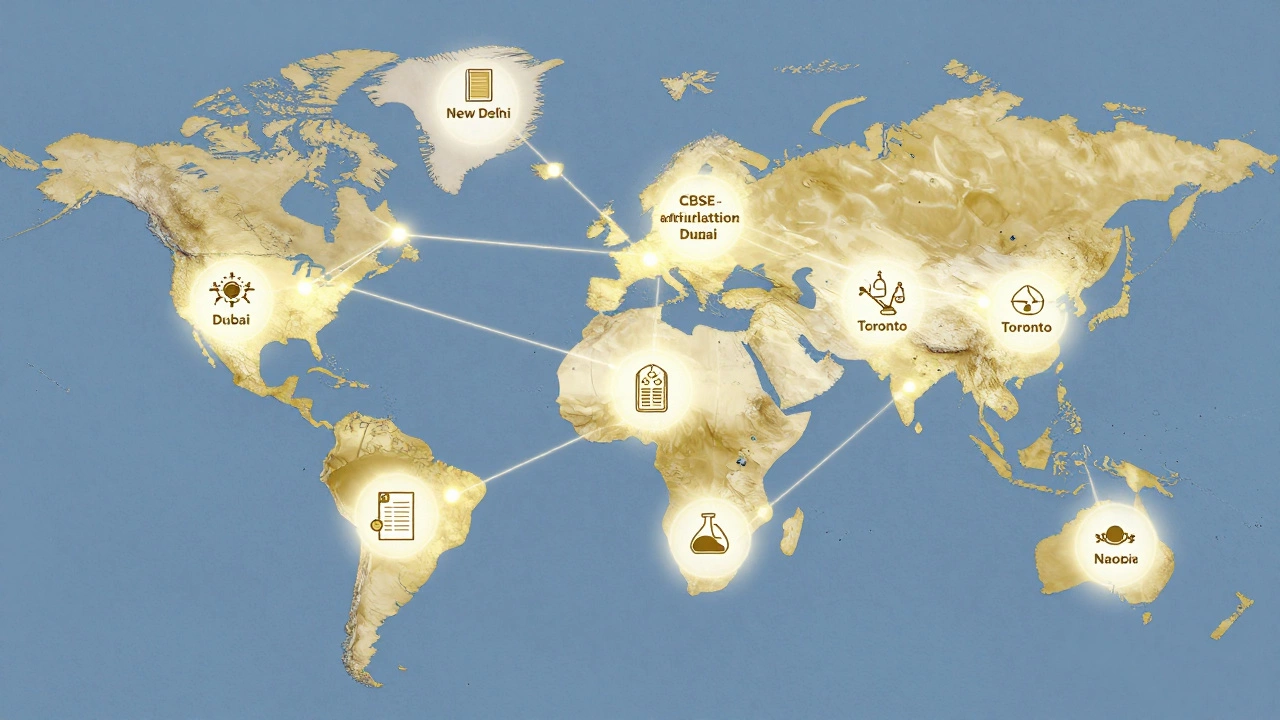
CBSE is controlled by the Government of India under the Ministry of Education. Its headquarters are in New Delhi, but its reach goes far beyond. Over 25,000 schools in India and more than 250 schools in 28 other countries follow CBSE’s curriculum. That includes schools in the UAE, Qatar, Kuwait, Kenya, and even Canada. If your child is enrolled in an Indian international school, they’re likely following CBSE guidelines.
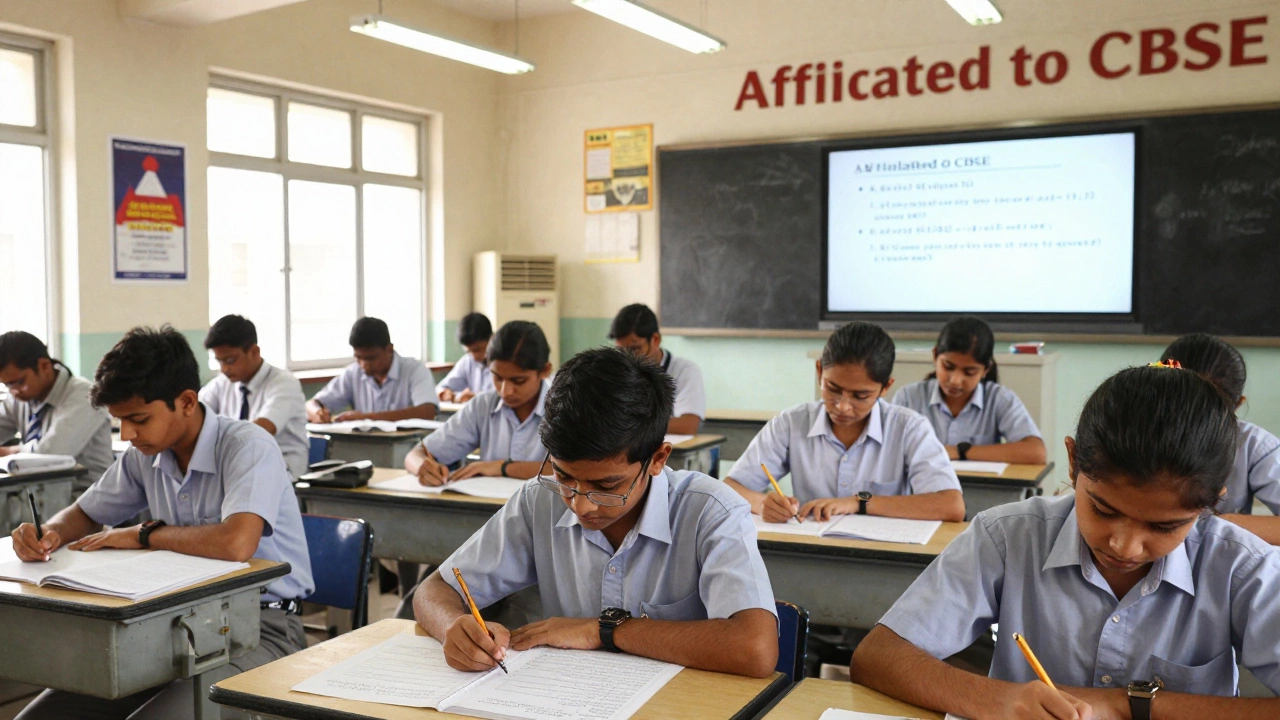
The board doesn’t just set the syllabus-it also designs the exam pattern, publishes sample papers, trains teachers, and even approves textbooks. Schools must get CBSE’s permission to operate as affiliated institutions. That’s why you’ll see the phrase “Affiliated to CBSE” on school websites and letterheads.
What’s the Difference Between CBSE and Other Boards?
India has multiple education boards, but CBSE is one of the most widely recognized. Compare it to state boards like Maharashtra State Board or ICSE (Council for the Indian School Certificate Examinations). State boards focus more on regional languages and local content. ICSE tends to have a broader, more detailed syllabus with heavier emphasis on English and literature.
CBSE, on the other hand, is designed to be uniform and exam-focused. Its syllabus is structured to align with national competitive exams like JEE (for engineering) and NEET (for medical). That’s why so many parents choose CBSE-even if they live in a state with a different board. They want their kids to be ready for national-level tests early on.
For example, in Class 10, CBSE students study the same Physics, Chemistry, and Biology chapters whether they’re in Delhi or Dubai. The exam papers are standardized, and marking schemes are published in advance. This predictability is a big reason why CBSE is popular among families who move frequently or plan to pursue higher education in India’s top colleges.
How Does CBSE Structure Its Curriculum?
CBSE divides education into three stages: primary (Classes I-V), upper primary (VI-VIII), and secondary (IX-XII). The board updates its syllabus every few years to reflect changes in science, technology, and global education trends. The 2024-2025 syllabus, for instance, added new modules on artificial intelligence basics in Class 8 and digital safety in Class 10.
For Class 10 and 12, CBSE conducts two major exams: the All India Secondary School Examination (AISSE) and the All India Senior School Certificate Examination (AISSCE). These aren’t just school tests-they’re gateways to colleges, scholarships, and even government jobs. A student’s CBSE Class 12 score can determine whether they get into IIT, AIIMS, or a top university abroad.
CBSE also introduced a competency-based assessment system in 2023. Instead of just memorizing facts, students now answer questions that test how well they can apply knowledge. For example, instead of asking “What is photosynthesis?” a question might say: “A plant in your balcony isn’t growing well. Using what you know about photosynthesis, suggest three reasons why and how to fix it.”
Why Do So Many Families Prefer CBSE?
There are practical reasons why CBSE dominates in Indian households. First, it’s the most common board for students aiming for engineering or medicine. JEE and NEET are based directly on CBSE Class 11 and 12 content. If you’re studying under CBSE, you’re already aligned with the exam pattern.
Second, CBSE schools often have better infrastructure and trained staff. Many private schools that invest in labs, smart classrooms, and digital learning tools are CBSE-affiliated. That’s because the board encourages tech integration and offers training programs for teachers.
Third, CBSE results are accepted everywhere. Whether you’re applying to a university in Bangalore or Boston, your CBSE certificate is recognized. Even foreign universities like those in the UK, Australia, and the US accept CBSE scores for admissions. Some even use CBSE Class 12 marks to determine eligibility for scholarships.
For migrant families-like those working in the Gulf or expats in Toronto-CBSE provides continuity. Kids can switch from a school in Mumbai to one in Dubai without losing academic ground. The syllabus doesn’t change drastically from one country to another, which reduces disruption.
What Are the Downsides of CBSE?
It’s not perfect. Critics say CBSE is too focused on exams and doesn’t encourage creativity enough. Some students feel pressured by the high-stakes nature of Class 10 and 12 exams. There’s also less room for arts, music, or project-based learning compared to IB or ICSE schools.
Another issue is the language gap. While CBSE allows students to study in English, Hindi, or regional languages, most schools default to English. That can be tough for students from rural areas or non-English-speaking homes. The board has tried to fix this with bilingual textbooks and simplified language in newer editions, but progress is slow.
Also, because CBSE is so exam-driven, some schools focus only on what’s tested. Subjects like Social Science or Environmental Studies get less attention unless they’re part of the final exam. That means kids might learn how to solve a quadratic equation but not understand how climate change affects their community.
How CBSE Compares to ICSE, State Boards, and IB
| Feature | CBSE | ICSE | State Board | IB (International Baccalaureate) |
|---|---|---|---|---|
| Scope | National (India + global) | National (India-focused) | State-specific | Global |
| Exam Focus | High (JEE/NEET aligned) | Moderate (broad-based) | Low to moderate | Low (project-based) |
| Language | English, Hindi, regional | Primarily English | Regional language dominant | English or bilingual |
| Curriculum Depth | Standardized, streamlined | Detailed, comprehensive | Varies by state | Interdisciplinary, critical thinking |
| Best For | Students targeting JEE, NEET, or Indian universities | Students seeking strong English and humanities foundation | Students staying in-state for higher education | Students planning to study abroad |
What Happens After CBSE Class 12?
After Class 12, CBSE students have several paths. Most aim for competitive exams: JEE for engineering, NEET for medicine, CUET for university admissions, or CLAT for law. Others apply directly to colleges using their CBSE scores. Some even take the SAT or ACT for U.S. universities.
CBSE also offers vocational courses in Class 11 and 12-like retail, tourism, healthcare, and IT. These are designed for students who don’t want to go the traditional academic route. The board partners with industries to make sure these courses match real job needs.
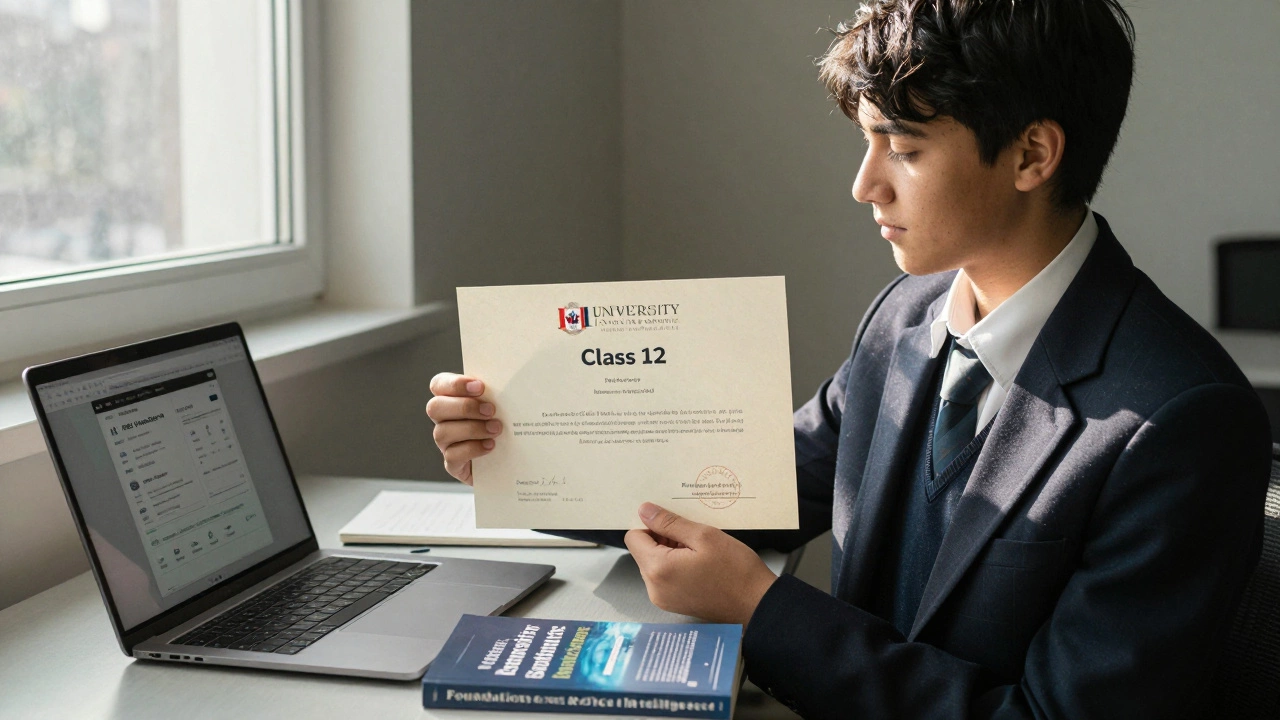
For students in Canada or the UK, CBSE Class 12 results are often converted into equivalent grades. For example, a 90% in CBSE might be seen as an A- or 85+ in Ontario’s system. Many Canadian universities have admission officers who are familiar with CBSE because of the large Indian diaspora.
Final Thoughts: Is CBSE Right for You?
CBSE isn’t the only path, but it’s one of the most reliable. If your goal is to enter Indian engineering or medical colleges, CBSE gives you the clearest roadmap. If you’re an expat family wanting stability across countries, it offers consistency. If you’re looking for a board that’s recognized worldwide and prepares students for real-world problem-solving, CBSE delivers.
But it’s not about choosing the "best" board-it’s about choosing the one that fits your child’s goals. If they love art and writing, maybe ICSE or IB is better. If they’re in a rural town with limited resources, a state board might be more practical. CBSE works best when it’s matched with the right support system: good teachers, consistent practice, and a mindset that values learning over just marks.
What does CBSE stand for in education?
CBSE stands for Central Board of Secondary Education. It is the national board responsible for conducting exams and setting curriculum standards for schools across India and in many international locations.
Is CBSE better than ICSE?
It depends on your goals. CBSE is more focused on science and math, making it ideal for students preparing for JEE or NEET. ICSE has a broader syllabus with more emphasis on English, literature, and projects. If you’re aiming for top Indian technical colleges, CBSE is usually the preferred choice.
Is CBSE recognized in Canada and the USA?
Yes. Canadian and U.S. universities accept CBSE Class 12 results for undergraduate admissions. Many institutions have specific conversion tables for CBSE percentages. For example, a 90% in CBSE is often treated as equivalent to a 3.7 GPA in the U.S. system.
Does CBSE include practical exams?
Yes. CBSE requires practical exams for subjects like Physics, Chemistry, Biology, Computer Science, and Mathematics. These are conducted in school labs and carry 20-30% weightage in the final score. The board also introduced internal assessments and project work starting in 2023.
Can I switch from another board to CBSE?
Yes, but only at specific entry points-usually Class 9 or Class 11. You’ll need to submit your previous school records and may need to take a placement test. Some schools also require you to complete bridging courses in subjects like Science or English before joining.
What is the passing mark in CBSE Class 10?
To pass CBSE Class 10, students must score at least 33% in each subject, both in theory and practical exams (if applicable). The overall passing criteria is also based on 33% across the total marks. Failure in one subject means you must appear for a compartment exam.
What’s Next for CBSE?
CBSE is moving toward more skill-based learning. Starting in 2025, the board plans to introduce a new elective called "Foundations of Artificial Intelligence" for Class 8. It’s part of a larger push to prepare students for future jobs, not just exams. The board is also working with tech companies to offer free digital resources-like video lessons and AI-powered practice tools-to all affiliated schools.
For parents and students, the message is clear: CBSE isn’t just about marks anymore. It’s about building adaptable learners who can think, solve problems, and keep learning-even after the final exam is over.