What Are the 5 eLearning Models Used Today?
 Jan, 13 2026
When you sign up for an online course, you don’t just get videos and quizzes. Behind every course is a design plan - a model that decides how content is delivered, how learners interact, and what actually sticks. Not all eLearning is the same. Some courses feel like a lecture you can pause. Others feel like a conversation that never ends. The difference? The eLearning model used.
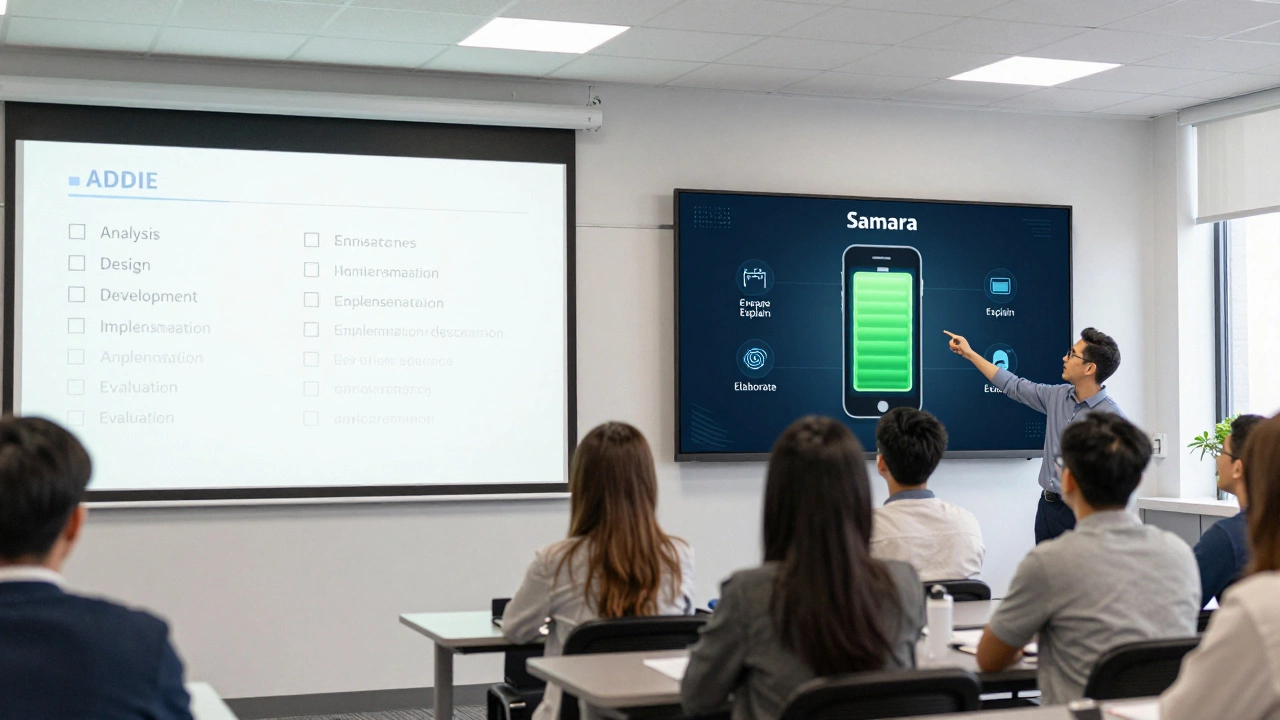
ADDIE Model
The ADDIE model is the oldest and still the most common framework in eLearning. It stands for Analysis, Design, Development, Implementation, and Evaluation. It’s linear, structured, and works best for formal training programs - like corporate onboarding or university modules.
Here’s how it breaks down:
- Analysis: Who are the learners? What do they already know? What’s the gap?
- Design: What learning objectives will close that gap? What assessments will prove it?
- Development: Build the content - videos, slides, interactive exercises.
- Implementation: Roll it out to learners. Train the instructors.
- Evaluation: Did it work? Collect feedback. Fix what’s broken.
ADDIE isn’t flashy, but it’s reliable. Companies like IBM and Deloitte still use it for compliance training because it leaves a paper trail. But it’s slow. If you need to update a course every three months because regulations change, ADDIE will make you wait.
Samara Model
The Samara Model is less known but growing fast in K-12 and adult education. It was developed by researchers at the University of Toronto to fix ADDIE’s rigidity. Instead of following steps in order, Samara treats learning as a cycle: Engage, Explore, Explain, Elaborate, Evaluate.
Think of it like a science lab:
- Engage: Start with a real problem - ‘Why does your phone battery die so fast?’
- Explore: Let learners play with simulations, watch short clips, or test theories.
- Explain: Now introduce the science - energy conversion, battery chemistry.
- Elaborate: Apply it. ‘Design a solar-powered charger for your phone.’
- Evaluate: Peer review. Self-assessment. Reflect.
This model works because it matches how the brain learns: curiosity first, theory second. Platforms like Khan Academy and Duolingo use this approach without calling it Samara. It’s the reason people stick with apps that feel like games, not textbooks.
Backward Design Model
Backward Design flips the script. Instead of starting with content, you start with the end goal. It was popularized by Grant Wiggins and Jay McTighe in education circles. The rule? Decide what success looks like before you build anything.
Here’s the process:
- Identify the desired result - e.g., ‘Learners will be able to write a business proposal that wins funding.’
- Design assessments that prove they can do it - a live pitch, a written plan, peer feedback.
- Then build the lessons that lead to that outcome.
This model is brutal in its simplicity. No fluff. No ‘nice-to-know’ facts. Every video, quiz, and discussion must serve the final goal. It’s used heavily in MBA programs and professional certification courses like PMP or CFA.
If you’ve ever taken a course where everything felt focused and nothing was wasted - that’s Backward Design. It’s not for casual learners. It’s for people who need to prove they can do something, not just know about it.

4C/ID Model
The 4C/ID Model - short for Four-Component Instructional Design - was created by Jeroen van Merriënboer for complex skill training. It’s perfect for jobs that require decision-making, not just recall. Think nursing, aviation, customer service, or software troubleshooting.
It has four parts:
- Learning Tasks: Real-world problems learners must solve - e.g., ‘Diagnose why a patient’s blood pressure dropped after surgery.’
- Supportive Information: Background knowledge - rules, principles, guidelines.
- Procedural Information: Step-by-step instructions for specific actions - ‘How to use a defibrillator.’
- Part-Task Practice: Repeated drills on specific sub-skills - practicing IV insertion in a simulator.
What makes 4C/ID powerful is how it handles complexity. Instead of teaching everything at once, it layers skills. You learn the easy parts first, then add harder decisions. It’s used by hospitals, airlines, and tech companies training technicians. If your course feels like a simulation with real stakes, it’s probably built on 4C/ID.
Community of Inquiry (CoI) Model
Not all learning is about content. Sometimes, it’s about connection. The Community of Inquiry Model, developed by researchers at the University of Alberta, says effective eLearning needs three elements: Teaching Presence, Social Presence, and Cognitive Presence.
Here’s what each means:
- Teaching Presence: The instructor designs the course, guides discussions, and gives feedback. Not just posting videos - being active.
- Social Presence: Learners feel like they’re with real people. They share stories, ask questions, laugh at memes in the forum.
- Cognitive Presence: Learners think deeply. They debate, reflect, solve problems together.
This model is the backbone of successful online degrees from universities like Athabasca and the University of British Columbia. It’s why some MOOCs fail - no one’s talking. And why others thrive - learners form study groups, tag instructors in posts, and keep the conversation going for months.
It’s not about the platform. It’s about the culture. A course built on CoI feels alive. You don’t just complete it. You become part of it.

Which Model Is Right for You?
There’s no single ‘best’ model. The right one depends on your goal.
- Need compliance training? ADDIE - slow but audit-proof.
- Teaching kids or adult learners to stay curious? Samara - let them explore first.
- Preparing someone to pass a certification? Backward Design - focus only on what’s tested.
- Training for high-stakes jobs? 4C/ID - build skills step by step.
- Running a degree program? CoI - make it human.
Many modern platforms mix models. A course might use Backward Design for structure, Samara for engagement, and CoI for community. The key is knowing what you’re trying to achieve - and choosing the model that matches.
Common Mistakes to Avoid
Most eLearning fails not because of bad tech - but bad design.
- Don’t just dump videos and call it a course. That’s not a model - that’s laziness.
- Don’t force ADDIE on a creative subject like design or writing. It kills spontaneity.
- Don’t ignore social presence. People learn with others, not just from content.
- Don’t assume learners will figure it out. Even smart people need clear paths.
The best eLearning doesn’t just inform. It changes behavior. That takes intention. Pick a model. Stick to it. Build around it.
What is the most popular eLearning model today?
The ADDIE model is still the most widely used, especially in corporate and government training, because it’s structured and easy to document. But newer models like Samara and Community of Inquiry are gaining ground in K-12, higher education, and professional development because they focus on engagement and real-world application.
Can I mix different eLearning models?
Yes, and many effective courses do. For example, you might use Backward Design to define the final outcome, Samara to structure the learning journey, and Community of Inquiry to build discussion forums. Mixing models lets you balance structure with flexibility and engagement.
Is there a model that works best for adult learners?
The Community of Inquiry model works especially well for adult learners because it respects their experience and encourages peer-to-peer learning. Adults learn best when they can connect new knowledge to real-life problems and discuss them with others. Models like 4C/ID also work well for adults in technical or professional roles.
How do I know which model to choose for my course?
Ask yourself: What should learners be able to DO after finishing? If it’s pass a test, use Backward Design. If it’s handle emergencies, use 4C/ID. If it’s stay motivated and think critically, use Samara or CoI. Match the model to the outcome, not the tool.
Do I need special software to use these models?
No. These are instructional design frameworks, not tools. You can use any platform - Moodle, Teachable, Thinkific, or even a simple Google Doc - as long as you design the experience around the model. The software just delivers the content. The model decides how it works.