How to Train Your Brain to Speak English Confidently
 Mar, 20 2026
Want to speak English without freezing up, second-guessing every word, or worrying about sounding silly? You’re not alone. Millions of people learn English grammar perfectly but still can’t say a full sentence out loud without panic setting in. The problem isn’t your vocabulary. It’s your brain. You’ve trained it to think in your native language, to translate, to overanalyze - not to speak. The good news? You can retrain it. Not with more textbooks. Not with perfect pronunciation drills. But with simple, daily habits that change how your brain reacts when it’s time to talk.
Stop translating. Start thinking in English.
Your brain is stuck in translation mode. Every time you want to say something, you silently think in your first language, then hunt for the English words. That delay? It’s what makes you sound slow, hesitant, or awkward. The fix isn’t learning more words. It’s cutting the middleman.
Start small. For 10 minutes every morning, describe what you see out your window - not in your head, but out loud. Don’t worry about grammar. Say things like, “Sun is bright. Bird on tree. Car going fast.” You’re not practicing perfect sentences. You’re training your brain to bypass translation. A study from the University of Edinburgh found that learners who practiced direct thinking in English improved fluency 40% faster than those who translated mentally. It’s not magic. It’s rewiring.
Speak before you’re ready.
You don’t need to be perfect to speak. You need to speak to become perfect. Waiting for confidence to show up first is like waiting for your legs to get strong before walking. They only get strong by walking.
Find one low-stakes situation every day to speak English. Talk to a mirror. Record yourself answering a simple question like, “What did you eat for breakfast?” Play it back. Don’t cringe. Listen for patterns. Notice how often you say “um” or pause. That’s data, not failure. A teacher in Mexico City asked her students to speak for just 60 seconds daily - no corrections allowed. After six weeks, 87% of them stopped avoiding conversations. They weren’t suddenly fluent. But they stopped fearing mistakes.
Use shadowing to build muscle memory.
Shadowing isn’t about copying accents. It’s about syncing your mouth and brain. Pick a short audio clip - a podcast, a YouTube video, even a movie scene. Play it. Pause. Say exactly what you heard, right after it. Match the rhythm. The pauses. The tone. Don’t think about meaning. Just mimic.
Why does this work? Your brain learns movement patterns the same way it learns to ride a bike. When you shadow a native speaker for 15 minutes a day, you’re not memorizing phrases. You’re teaching your tongue, lips, and vocal cords how English sounds feel. A 2024 study from the British Council showed that learners who shadowed daily improved their speaking speed by 32% in just four weeks. And their confidence? It rose along with it.
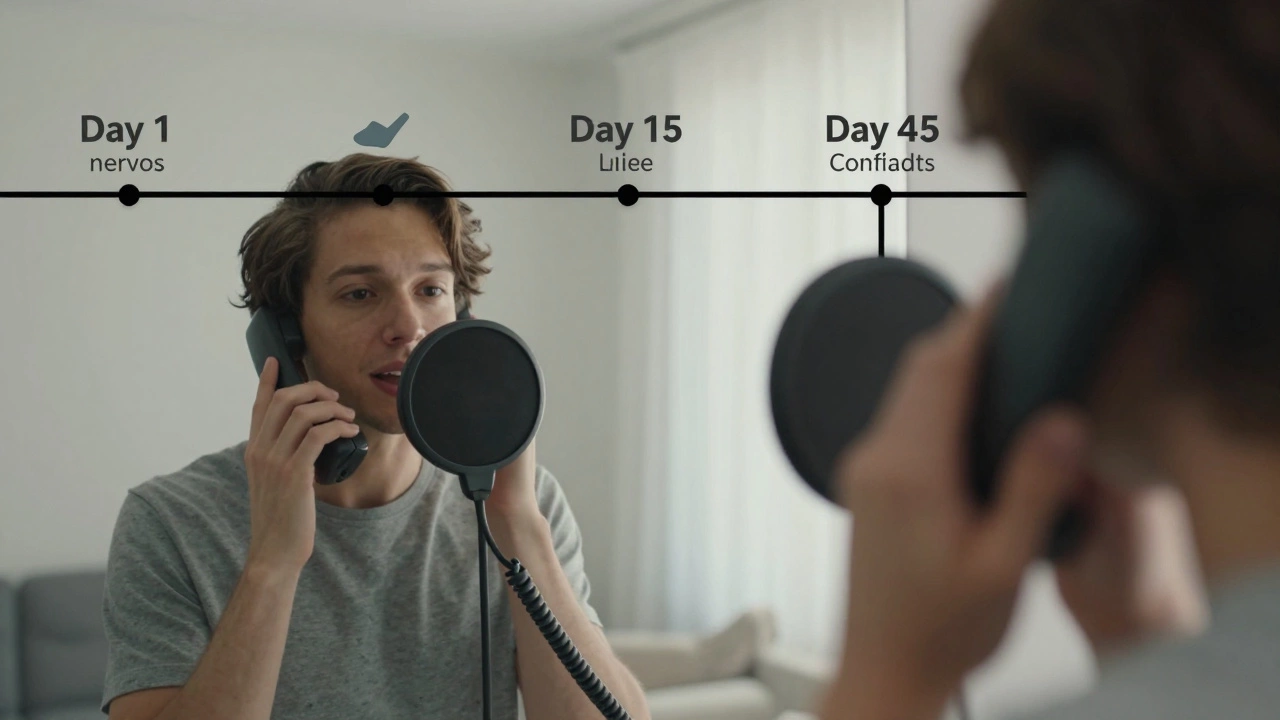
Change your environment. Change your brain.
Your brain responds to what it hears. If you’re surrounded by your native language, your brain assumes English is optional. But if you force English into your space, it starts treating it like home.
Switch your phone, apps, and social media to English. Watch one TV show or YouTube video in English every day - even if you only understand half. Listen to English music while commuting. Read headlines aloud. You’re not trying to understand everything. You’re training your ears to accept English as normal. Your brain will stop seeing it as foreign. And when it stops feeling foreign, speaking it stops feeling scary.
Build a feedback loop - not a fear loop.
Most people avoid speaking because they fear judgment. But the real fear isn’t the listener. It’s the voice inside your head saying, “You’ll mess up.” Break that cycle by creating a feedback loop, not a fear loop.
Find one person you trust - a friend, a tutor, even an online language partner - and agree to speak for 10 minutes, twice a week. After each session, ask just two questions: “What did I say clearly?” and “Where did I get stuck?” No corrections. No grammar lectures. Just honest, simple feedback. Keep a notebook. Write down the answers. Over time, you’ll see patterns. Maybe you always freeze on past tense. Maybe you forget to use articles. You’ll know exactly where to focus. And knowing what to fix? That’s confidence.

Embrace the pause.
Native speakers pause. A lot. They don’t rush. They think, then speak. But learners think they have to fill every silence with words. That’s why you sound rushed or nervous. The goal isn’t to speak nonstop. It’s to speak with control.
When you’re speaking and you blank out? Don’t panic. Breathe. Say “Let me think for a second.” Or just smile and pause. That’s okay. In fact, it’s normal. A Harvard study on communication found that people who used natural pauses were rated as 50% more confident than those who rushed. Pauses aren’t gaps. They’re breathing room. Give yourself permission to take them.
Track progress, not perfection.
Confidence doesn’t come from speaking flawlessly. It comes from knowing you’re getting better. Keep a simple log. Every week, write down:
- One thing you said clearly
- One new phrase you used
- One situation where you spoke without fear
After a month, look back. You’ll see progress you didn’t notice day-to-day. Maybe you spoke to a cashier. Maybe you asked for help without apologizing. Maybe you laughed while making a mistake. Those aren’t small wins. They’re proof your brain is changing.
It’s not about being perfect. It’s about being heard.
You don’t need to sound like a native speaker. You need to be understood. And you will be - if you speak with calm, clear intent. People care more about your message than your grammar. They want to know what you think, not how you conjugate verbs.
Every time you speak, you’re not practicing English. You’re practicing courage. And courage grows with use. Not with perfect tests. Not with grammar drills. With real, messy, slightly awkward conversations.
Start tomorrow. Not with a class. Not with a textbook. With one sentence. Out loud. Just one. And then another. Your brain will follow.
How long does it take to speak English confidently?
There’s no fixed timeline - it depends on how consistently you practice. Most people notice a shift in 3 to 6 weeks if they do just 15-20 minutes of speaking practice daily. Confidence grows faster than fluency. You don’t need to know 10,000 words to speak confidently. You need to speak often. A 2023 survey of 2,100 adult English learners found that 72% felt significantly more confident after just 45 days of daily speaking, even if they only practiced 10 minutes a day.
Can I train my brain to speak English without a teacher?
Yes. Teachers help with feedback, but they’re not required for building confidence. Many people improve just by using free tools: shadowing audio, recording themselves, speaking to mirrors, joining online conversation groups. The key is consistent, low-pressure practice. You don’t need someone to correct you - you need someone to listen. Even if it’s just your own recording. Your brain learns from repetition, not perfection.
Why do I freeze up even when I know the words?
It’s not about vocabulary. It’s about stress response. When you’re afraid of making mistakes, your brain triggers a fight-or-flight reaction. Your prefrontal cortex - the part that handles language - shuts down. That’s why you know the word but can’t say it. The solution? Reduce pressure. Practice in safe, low-stakes settings. The more you speak without fear of judgment, the less your brain will panic. Over time, speaking becomes routine, not risky.
Is it better to practice alone or with others?
Both matter - but alone first. You need to build comfort with your own voice before speaking with others. Start with shadowing, recording, and talking to yourself. Once you can say a full sentence without flinching, then add real conversations. Practicing with others too early can reinforce fear. Practicing alone builds the foundation. Think of it like learning to swim: you practice floating in the shallow end before diving into deep water.
What if I make a mistake and people laugh?
Most people don’t laugh at mistakes - they admire the courage to speak. If someone does react negatively, it says more about them than you. Real speakers don’t focus on errors. They focus on connection. If you’re worried about this, start with online communities where everyone is learning. Platforms like Tandem or HelloTalk connect learners who understand the struggle. You’ll find more support than judgment.
Should I focus on pronunciation or fluency first?
Fluency. Clear pronunciation helps, but perfect accents aren’t needed for confidence. People understand you if you speak slowly and clearly. Focus on being understood, not sounding native. A 2025 study from Cambridge found that learners who prioritized fluency over pronunciation were 60% more likely to keep speaking regularly. Once you’re speaking without fear, you can fine-tune pronunciation. Confidence comes first. Accuracy comes later.