How to Improve Your English Speaking Skills: A Practical Guide
 May, 8 2026
Personalized English Speaking Practice Plan
Select your goal and time commitment to see your personalized practice plan.
You know the grammar rules. You can read a complex article without stumbling over words. But when someone asks you a question in real life, your mind goes blank. This is the most common frustration for learners who have studied English a global lingua franca used for communication, business, and education worldwide for years but still struggle to speak it confidently. The gap between knowing a language and using it is not about intelligence; it is about habit.
Improving your spoken English requires shifting from passive consumption to active production. It is less about memorizing more vocabulary and more about rewiring your brain to process sounds and structures automatically. If you want to move from hesitant pauses to smooth conversations, you need a strategy that targets muscle memory, psychological barriers, and consistent exposure.
The Core Problem: Passive vs. Active Knowledge
Most learners fall into the trap of passive learning. You watch Netflix with subtitles, read books, or listen to podcasts. This builds your receptive skills-what you understand-but it does little for your productive skills-what you say. Think of it like fitness. Reading about how to lift weights will not make your muscles stronger. You have to actually lift them.
In language learning, passive knowledge vocabulary and grammar you recognize but cannot produce quickly acts as a library in your head. active knowledge words and phrases you can retrieve instantly during conversation is the toolkit on your workbench. To improve speaking, you must move items from the library to the workbench. This happens only through repetition and usage under pressure.
Start with Shadowing: Train Your Mouth Muscles
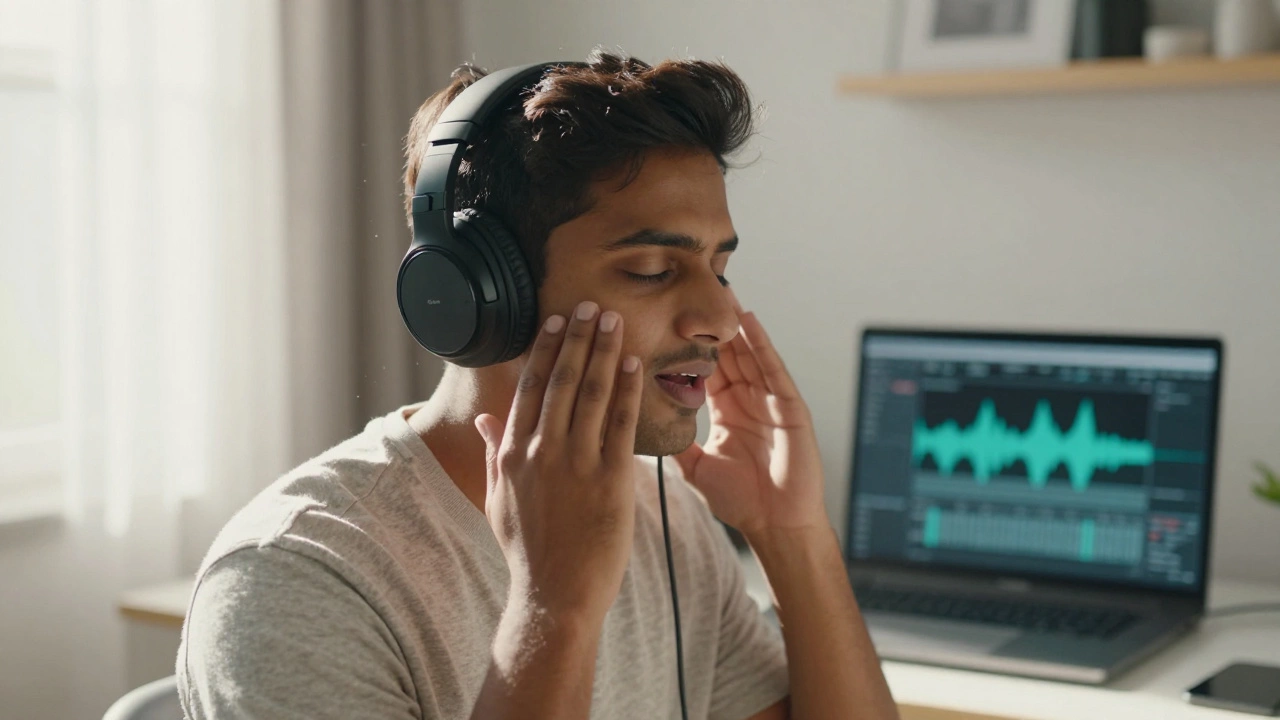
Your mouth is a muscle. Just like any other muscle, it needs specific training to perform new movements. English sounds often require tongue positions and lip shapes that are unfamiliar if your native language uses different phonetics. One of the most effective techniques for this is shadowing a technique where you repeat audio immediately after hearing it to mimic pronunciation and rhythm.
To practice shadowing:
- Find a short audio clip (1-2 minutes) of a native speaker. TED Talks, news segments, or even podcast interviews work well.
- Listen to one sentence, pause it, and repeat it exactly. Copy the intonation, the speed, and the emotion.
- Once comfortable, try to speak along with the audio simultaneously, lagging by just a fraction of a second.
This forces your brain to connect sound patterns with physical movement. Do this for 10 minutes daily. Over time, you will notice that your accent becomes clearer and your speech flows more naturally because your mouth is already trained for those specific English sounds.
Talk to Yourself: Remove the Pressure
Many people wait for a partner to practice with. But finding a willing conversation partner every day is hard. Instead, use yourself. Narrating your day out loud is a powerful way to build fluency without the fear of judgment.
While making coffee, say what you are doing: "I am pouring the hot water into the cup." While walking to work, describe what you see: "There is a red car parked near the blue building." This might feel silly at first, but it helps you identify gaps in your vocabulary. When you reach for a word and cannot find it, write it down. Look it up later. This turns daily routine into targeted study sessions.
Self-talk also reduces anxiety. By getting used to hearing your own voice speak English, you lower the mental barrier that causes stuttering or freezing during real interactions.

Use Technology to Simulate Real Conversations
In 2026, technology offers incredible tools for solo practice. Voice recognition software can act as an instant tutor. Apps like ELSA Speak an AI-powered app that provides feedback on pronunciation and accent reduction or similar platforms analyze your speech and tell you exactly which sounds are incorrect.
You can also use smart speakers. Ask your device questions and force yourself to answer them aloud. For example, ask, "What is the weather today?" Then, instead of just listening, summarize the answer out loud in three sentences. This creates a mini-conversation loop.
If you prefer human interaction but lack local partners, online communities offer low-stakes environments. Platforms dedicated to language exchange allow you to chat with people who want to learn your native language in return. These exchanges are mutually beneficial and remove the formal teacher-student dynamic that can cause stress.
Focus on Chunks, Not Individual Words
A major reason why speakers hesitate is that they translate word-by-word from their native language. This is slow and leads to unnatural phrasing. Instead, learn lexical chunks common groups of words that are frequently used together, such as 'on the other hand' or 'as a matter of fact'.
Native speakers do not construct sentences from scratch each time. They pull pre-made blocks of language from memory. For instance, instead of thinking of "I" + "would" + "like" + "to" + "go," treat "I would like to go" as a single unit. This speeds up retrieval and makes your speech sound more natural.
When you hear a useful phrase in a movie or conversation, write down the whole chunk, not just the keyword. Practice inserting these chunks into your self-talk. Over time, your brain will automate these connections, reducing cognitive load during real-time conversation.

Embrace Mistakes and Silence
Perfectionism is the enemy of fluency. Many learners stop speaking because they are afraid of making grammar mistakes. Remember, the goal of speaking is communication, not grammatical purity. Even native speakers make errors.
If you get stuck, do not switch to your native language. Use filler words like "well," "you know," or "let me think." This buys you time to formulate your thought while keeping the conversation flowing. Also, accept silence. A brief pause is better than filling the air with awkward noises. It shows you are processing information, which is part of normal dialogue.
Record yourself speaking once a week. Listen back critically but kindly. Note recurring errors-perhaps you consistently drop the "s" at the end of third-person verbs. Focus on correcting one specific error per week rather than trying to fix everything at once.
| Strategy | Best For | Time Commitment | Difficulty Level |
|---|---|---|---|
| Shadowing | Pronunciation & Rhythm | 10-15 mins/day | Medium |
| Self-Talk | Vocabulary Retrieval | Variable (daily) | Easy |
| Language Exchange | Real-time Interaction | 30-60 mins/week | Hard |
| Recording & Review | Error Correction | 10 mins/week | Medium |
Create an English-Only Environment
Your environment dictates your habits. If your phone, social media, and entertainment are all in your native language, your brain has no incentive to switch to English. Change your digital environment. Set your phone’s language to English. Follow English-speaking influencers on topics you enjoy, whether it is cooking, tech, or sports.
This immersion ensures that even when you are not actively studying, you are absorbing the language. You start to think in English because the inputs around you are in English. This subconscious processing reinforces the neural pathways needed for fluent speech.
How long does it take to improve English speaking skills?
It varies based on your current level and consistency. With daily practice of 30 minutes, noticeable improvement in fluency and confidence usually occurs within 3 to 6 months. Mastery is a lifelong process, but functional conversational ability can be achieved relatively quickly with focused effort.
Is it okay to make grammar mistakes when speaking?
Yes, absolutely. Minor grammar errors rarely hinder understanding. Focusing too much on perfection causes hesitation and slows down communication. Prioritize clear expression and flow. Correct grammar gradually through review and feedback rather than stopping mid-sentence to self-correct.
What is the best way to practice alone?
Narrating your daily activities out loud is highly effective. Describe what you are seeing, doing, or feeling in real-time. Combine this with shadowing exercises using audio clips. Recording yourself weekly allows you to track progress and identify specific areas for improvement without needing a partner.
Can watching movies help me speak better?
Watching movies helps with listening comprehension and cultural context, but it is passive. To improve speaking, you must engage actively. Use movies for shadowing practice. Pause scenes and repeat lines. Analyze the emotions and intonations used by characters to enhance your own expressive range.
Why do I forget words when I speak?
Forgetting words often happens because you rely on translation rather than direct association. When you learn a word, connect it to an image or experience, not its native language equivalent. Additionally, anxiety blocks memory retrieval. Practicing in low-pressure environments like self-talk reduces this blockage over time.