Fastest Online Degrees: How to Get Your Qualification Quickly
 Apr, 17 2026
Degree Graduation Timeline Estimator
Estimate how quickly you can earn your qualification by factoring in your experience and the program type.
Estimated Completion Time:
Stop guessing and start graduating
You've probably spent hours scrolling through university pages, feeling like you're staring at a wall of academic jargon. The reality is that most people don't actually want a four-year trek through lecture halls; they want the credential that unlocks the higher salary or the new job title. Whether you're trying to pivot your career in 2026 or you're just tired of being the only person in the office without a degree, the clock is ticking. The good news? The traditional timeline is dead. Between competency-based models and accelerated terms, you can now shave years off your education without sacrificing the legitimacy of the piece of paper.
Quick Wins for Fast Graduation
- Competency-Based Education (CBE): The fastest route. You move forward as soon as you prove you know the material.
- Associate Degrees: Usually take 2 years, but can be finished in 12-18 months online.
- Prior Learning Assessment (PLA): Turns your work experience into college credits.
- Accelerated Terms: Programs that run 8-week courses instead of 16-week semesters.
The secret weapon: Competency-Based Education
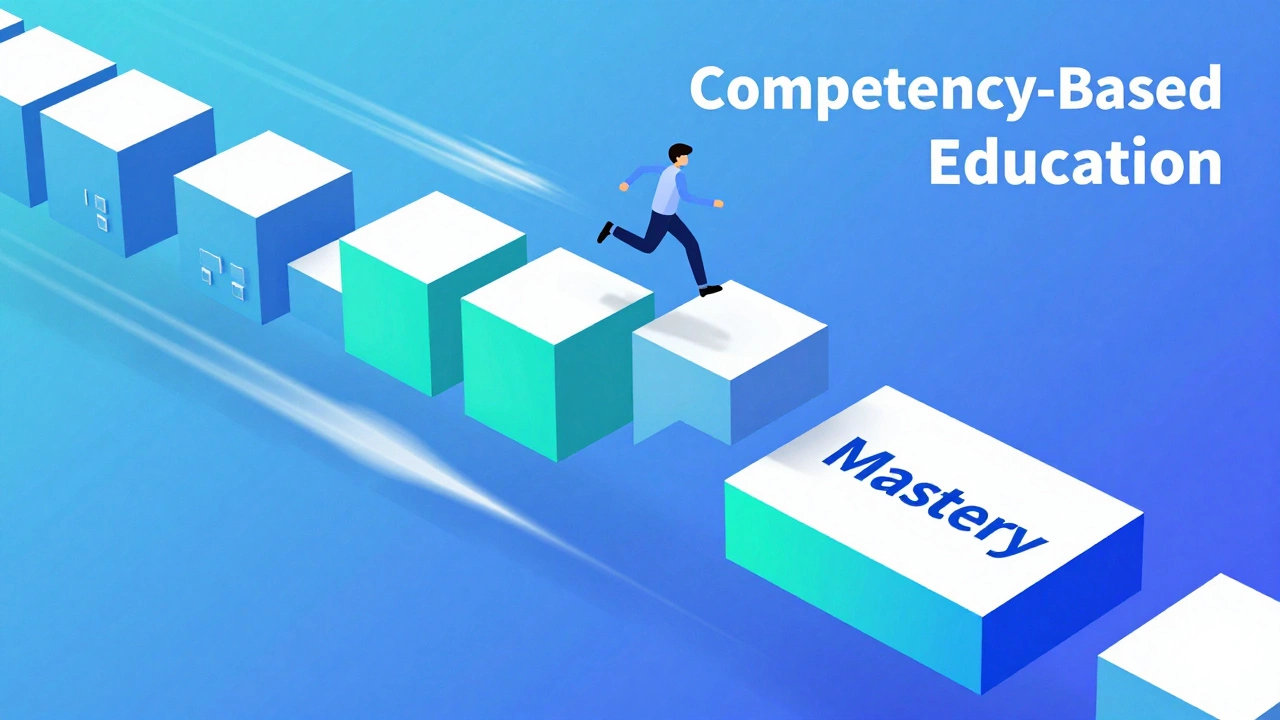
If you want the absolute fastest path, you need to look for Competency-Based Education (CBE). CBE is an instructional model where students progress based on their ability to master a skill or concept regardless of time spent in a classroom. Unlike a traditional class where you sit through 15 weeks of lectures even if you already know the topic, CBE lets you take a pre-assessment. If you pass, you're done with the course. Period.
Imagine you're an experienced project manager who needs a degree in Business Administration. In a traditional program, you'd spend months learning how to make a Gantt chart. In a CBE program, you prove you can do it on day one, check the box, and move to the next module. This is how some students finish a full degree in under two years. It requires massive self-discipline, but the payoff is a drastically shorter time to graduation.
Which degrees actually move the fastest?
Not all degrees are created equal when it comes to speed. Some require clinical hours or lab work that simply cannot be accelerated. If speed is your primary goal, you should target these specific paths:
Associate Degrees: These are two-year degrees, but in the online world, they are the quickest degree to get online. Because they focus on foundational knowledge and technical skills, they are easier to compress. Many online community colleges allow you to take "overloads"-meaning you take 6 or 7 classes a term instead of 4-allowing you to finish in about a year.
Bachelor of Science in Professional Studies: These are often designed for working adults. They lean heavily on a Prior Learning Assessment (PLA), which means the university reviews your professional certifications or years of work experience and grants you college credits for them. If you've worked in a field for five years, you might enter a program with 30 credits already completed.
Certificates and Diplomas: While not a full degree, these are the "sprint" version of education. A professional certificate in Data Analytics or Digital Marketing can often be completed in 6 months and provides immediate leverage for a raise.
| Degree Type | Traditional Duration | Accelerated Potential | Best For... |
|---|---|---|---|
| Associate Degree | 2 Years | 12 - 18 Months | Entry-level pivots, technical roles |
| Bachelor's (CBE) | 4 Years | 1.5 - 3 Years | Experienced professionals |
| Bachelor's (Standard) | 4 Years | 3 Years | Students preferring structure |
| Professional Cert | N/A | 3 - 9 Months | Skill-specific upgrades |
How to hack your timeline without losing quality
Speed is great, but a degree from a "diploma mill" is useless. To move fast while staying credible, you need to employ a few specific strategies. First, look for Accreditation. Accreditation is a quality assurance process that ensures an educational institution meets established standards. Always check for Regional Accreditation in the US or recognized national bodies in other countries. If they aren't accredited, the degree won't be recognized by HR departments.
Second, maximize your transfer credits. Many students ignore the possibility of using CLEP exams (College-Level Examination Program). These are standardized tests that allow you to test out of introductory courses. Instead of taking a semester-long Psychology 101 course, you study for two weeks, take the exam, and get the credit instantly. Combining CLEP with a CBE program is the ultimate "speed run" for a bachelor's degree.
Third, choose a program with 8-week terms. Traditional semesters are 16 weeks. Programs that split these into two 8-week sessions keep you in a constant state of momentum and allow you to graduate faster by eliminating the long summer breaks typical of traditional universities.
The pitfalls of the fast track
It sounds amazing to finish a degree in record time, but there's a catch. The pressure is intense. In a CBE model, there is no professor reminding you to turn in a paper on Friday. You are the manager of your own time. If you hit a wall in a difficult subject, you can't just "wait for the next week"-you're stuck until you master the concept.
There is also the risk of "surface learning." When you race through material just to get the credit, you might miss the nuances that actually make you an expert. For example, if you're getting a degree in Business Administration, knowing how to pass the test on accounting is different from knowing how to manage a company's actual books during a tax audit. Balance your speed with actual application.

Choosing the right path for your goal
Before you sign up, ask yourself what the degree is actually for. If you need a checkbox for a corporate promotion, the fastest accredited Associate or Bachelor's is your best bet. If you need deep technical expertise in a field like Computer Science, rushing through the degree might actually hurt your prospects because the technical interviews will expose any gaps in your knowledge.
For those who are truly undecided, starting with a Community College online program is the smartest move. You get the same foundational credits as a prestigious university but at a fraction of the cost and often with more flexible, faster-paced schedules. Once you have the Associate degree, you can transfer those credits to a larger university to finish the Bachelor's.
Can I really get a degree in one year?
Yes, but usually only for Associate degrees or specialized certificates. For a Bachelor's degree, finishing in one year is extremely rare and usually requires a massive amount of transfer credits from previous work or CLEP exams. Most "fast" Bachelor's programs take 1.5 to 2 years.
Are fast online degrees respected by employers?
As long as the institution is regionally accredited, most employers don't care how long it took you to finish. They care that you have the credential and the skills. In fact, graduating quickly often signals high motivation and time-management skills to a recruiter.
What is the difference between a degree and a certificate?
A degree (Associate, Bachelor's, Master's) is a comprehensive academic qualification that covers a broad range of subjects. A certificate is a focused credential that proves you've mastered a specific skill set. Degrees take longer but have more long-term value; certificates are faster and provide immediate tactical utility.
How do I find if a program is "Competency-Based"?
Look for keywords like "CBE," "self-paced," or "mastery-based learning" on the university's website. If the program mentions a fixed 16-week semester for every course, it is not CBE. Programs that allow you to "test out" of modules are typically competency-based.
Does taking a fast degree cost more?
Actually, it often costs less. Many CBE programs charge a flat fee per "term" or "subscription" regardless of how many courses you complete. If you are fast, you can finish more credits for the same price, significantly lowering your total tuition cost.
Next steps for your acceleration
If you're ready to start, don't just apply to the first site you see. Start by auditing your own life-list every certification you have, every professional project you've led, and every skill you've mastered. This list will be your primary tool when talking to admissions officers about Prior Learning Assessments.
Next, decide if you need the full prestige of a Bachelor's or if an Associate degree gets you where you need to be. If you're in a hurry, the Associate degree is your best entry point. Finally, set a strict weekly schedule. The biggest enemy of the fast-track degree isn't the difficulty of the material-it's the lack of a deadline. Without a professor breathing down your neck, your only boss is your own calendar.