Which MBA Is Best Paid? Top Schools and Specializations for Maximum Salary in 2026
 Jun, 16 2026
MBA Return on Investment (ROI) Calculator
Your Financial Profile
Investment Analysis
Enter your details to see if the MBA pays off.
You spend two years of your life and often a significant chunk of your savings to get an MBA is a Master of Business Administration degree designed to develop managerial skills and business knowledge. Naturally, you want that investment to pay off. The question isn't just "which school is prestigious?" It's "which path leads to the highest paycheck?" If money is your primary metric, not every business school or specialization is created equal.
The data from 2025 and early 2026 is clear: the highest salaries cluster around specific industries-primarily finance and consulting-and specific geographic hubs like New York, San Francisco, and London. But there is nuance. A general management degree from a top-tier school might land you a great job, but it won't always beat a specialized track in private equity or quantitative finance. Let’s break down exactly where the money is hiding.
The Elite Tier: Where the Highest Base Salaries Live
If we look at raw starting compensation, the conversation almost always starts with the "M7" or "T1" schools. These are the institutions that dominate recruitment for high-paying roles. In 2025, the median total compensation (base salary + bonus) for graduates from schools like Harvard Business School is the graduate school of Harvard University, known for its case method teaching and influential alumni network, Stanford Graduate School of Business is a business school located on the campus of Stanford University, renowned for entrepreneurship and technology sector connections, and Wharton School is the business school of the University of Pennsylvania, widely considered one of the top finance-focused business schools globally exceeded $200,000 USD.
Why these schools? It’s about access. Investment banks like Goldman Sachs and JPMorgan Chase have dedicated recruiting pipelines at these campuses. They aren't looking for potential; they are hiring for immediate performance in high-stakes environments. The prestige acts as a filter, allowing recruiters to hire efficiently. For you, this means that if your goal is maximum income, attending a school with strong ties to Wall Street or Silicon Valley is non-negotiable.
However, there is a catch. The cost of attendance at these schools can range from $200,000 to $250,000 when including tuition, fees, and living expenses. You must calculate the Return on Investment (ROI). If you graduate with $200,000 in debt and earn $200,000 in your first year, your net gain is zero after taxes. The true "best paid" MBA is one where the post-graduation earnings significantly outpace the total cost of education over a 3-to-5-year horizon.
Specialization Matters More Than You Think
Your choice of major or concentration plays a massive role in your final paycheck. While a general MBA offers flexibility, specialized tracks often command higher premiums because they address specific skill shortages in the market.
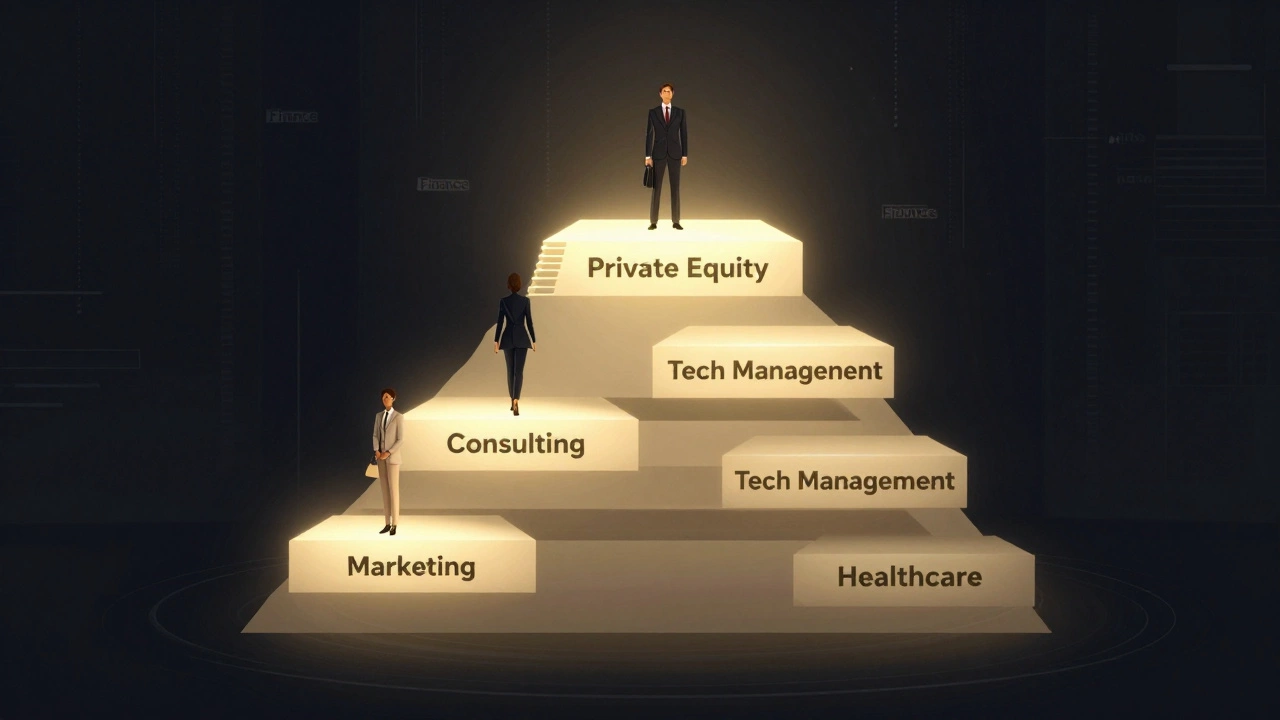
| Specialization | Median Total Compensation | Key Employers | Risk Factor |
|---|---|---|---|
| Finance is the management of money, including investments, banking, credit, and financial planning | $180,000 - $220,000+ | Investment Banks, Hedge Funds, Private Equity | High volatility, long hours |
| Consulting is the practice of providing expert advice to businesses to improve their performance | $170,000 - $200,000 | McKinsey, BCG, Bain (MBB firms) | Travel-intensive, project-based stress |
| Technology Management is the application of management principles to IT organizations and digital transformation | $160,000 - $190,000 | Tech Giants (FAANG), Startups | Rapidly changing tech stack |
| Marketing is the activity, set of institutions, and processes for creating, communicating, and exchanging offerings that have value | $140,000 - $160,000 | Consumer Goods, Tech Marketing Agencies | Lower entry barrier, competitive |
| Healthcare Administration is the management of health services organizations, such as hospitals and clinics | $130,000 - $150,000 | Hospital Systems, Pharma Companies | Regulatory complexity, slower growth |
Notice the gap between Finance/Consulting and other fields. If you want the absolute highest ceiling, Finance is the king. Specifically, roles in Private Equity is an alternative investment strategy involving investment into private companies or engagement in buyouts of public or private companies and Hedge Funds is a pooled investment fund that employs different strategies to earn active return for its investors often offer bonuses that double the base salary. However, these roles require intense preparation, often including internships during the MBA program itself.
Geography: Location Determines Paycheck Size
Where you study matters as much as what you study. The labor market for MBAs is highly localized. Graduating from a top school in India or Europe does not automatically grant you access to the same salary bands as graduating from a top school in the United States.
In the US, the highest concentrations of high-paying MBA jobs are in:
- New York City: The hub for finance, banking, and asset management. If you want to work in investment banking, NYC is essential.
- San Francisco Bay Area: The center for technology, venture capital, and product management. Salaries here are high due to the cost of living and the profitability of tech firms.
- Boston: Strong in healthcare, biotech, and hedge funds.
- Chicago: A major hub for commodities trading and corporate headquarters.
If you attend a school outside these hubs, you may face additional hurdles. Recruiters often prefer candidates who are already local or willing to relocate immediately. Some European schools, like INSEAD or London Business School, offer excellent global networks, but the starting salaries in Europe are generally lower than in the US, even after adjusting for purchasing power parity. Always check the employment report of the specific school to see where their graduates end up geographically.
Full-Time vs. Part-Time vs. Online: The Format Trap
A common misconception is that all MBAs lead to the same career outcomes. This is false. The format of your degree dictates your access to recruiters.
Full-Time MBA: This is the gold standard for career switchers and those seeking the highest salaries. It provides a structured period for internships, which are critical for landing full-time offers in finance and consulting. Most top-paying roles recruit exclusively from full-time cohorts.
Part-Time/Executive MBA: Designed for experienced professionals who are already working. These programs do not typically offer internship opportunities or on-campus recruiting for entry-level roles. Your salary increase comes from leveraging your existing experience rather than starting fresh. While some EMBA graduates see significant raises, they rarely match the explosive growth seen in full-time MBA graduates entering high-finance roles.
Online MBA: Generally, online MBAs do not provide the same level of access to top-tier recruiters. While they are excellent for skill acquisition and networking within your current industry, they rarely facilitate the kind of career pivot required to enter high-paying sectors like investment banking. If your goal is maximum salary, an online MBA is likely not the right tool unless you are already in a high-paying role and need the credential for promotion.
Calculating Your Personal ROI
To determine which MBA is "best paid" for *you*, you need to run the numbers. Don't just look at the median salary published by the school. Look at the distribution. Medians can hide the fact that only the top 10% of students land the big jobs.
Ask yourself these questions:
- What is my pre-MBA salary? If you are already earning $150,000, the opportunity cost of quitting work for two years is huge. You need a post-MBA salary of at least $250,000 to justify the break.
- What is the total cost? Include tuition, books, housing, and lost wages. For a two-year program, this can easily exceed $300,000.
- What is the target industry? If you want to work in tech, schools like Stanford, MIT Sloan, and UC Berkeley Haas have stronger networks than traditional finance schools. If you want finance, Wharton, Columbia, and Chicago Booth are superior.
- Are there scholarships? Many top schools offer merit-based aid. Securing a partial scholarship can dramatically improve your ROI.
A good rule of thumb: Aim for a program where your expected starting salary is at least 2x your total cost of attendance. If the math doesn’t work, consider waiting to save more money or targeting a slightly less expensive school with a strong regional reputation.

Pitfalls to Avoid
Chasing the highest salary can sometimes lead to poor decisions. Here are common traps:
The Brand Fallacy: Assuming any "top 10" school will yield high pay. In reality, the difference between rank #5 and rank #15 can be negligible in terms of salary, but the tuition difference might be significant. Focus on schools with strong placement records in your desired industry, not just overall rankings.
Ignoring Soft Skills: High-paying roles require more than just technical knowledge. Communication, leadership, and negotiation skills are critical. If you lack these, no amount of coursework will help you close the deal. Invest in coaching or extracurriculars that build these muscles.
Overlooking Networking: Your network is your net worth. Attend career fairs, join clubs, and connect with alumni. Many high-paying jobs are filled through referrals before they are ever posted publicly. Building relationships early in your program is essential.
Conclusion: Strategy Over Prestige
The "best paid" MBA is not a single degree. It is a strategic combination of school, specialization, location, and personal effort. For most people, this means attending a top-tier full-time program in the US, specializing in finance or consulting, and targeting roles in New York or San Francisco. However, if you are already established in a niche industry, a targeted Executive MBA or a specialized master’s in finance might offer a better ROI.
Do your homework. Talk to recent graduates. Ask them about their actual take-home pay, not just the headline numbers. Remember, the degree is just the ticket to the game. How you play determines how much you win.
Is an MBA worth it in 2026?
An MBA is worth it in 2026 if you aim for leadership roles in finance, consulting, or tech, where salaries significantly outpace the cost of the degree. For other industries, the ROI may be lower, so calculate your specific costs versus expected salary increases carefully.
Which MBA specialization has the highest salary?
Finance, particularly in investment banking, private equity, and hedge funds, consistently offers the highest starting salaries for MBA graduates, often exceeding $200,000 in total compensation.
Do online MBAs lead to high-paying jobs?
Generally, no. Online MBAs are less effective for career switching into high-paying fields like finance or consulting because they lack the on-campus recruiting and internship opportunities that full-time programs provide.
What is the average salary after an MBA?
The average starting salary varies by school and region. At top US schools, the median total compensation is often between $170,000 and $200,000. At mid-tier schools, it may range from $120,000 to $150,000.
Can I get a high-paying job with an Executive MBA?
Yes, but usually through promotions within your current company or industry. Executive MBAs are designed for experienced professionals, so they don't typically facilitate entry into new, high-paying fields like investment banking for beginners.