JEE Main vs JEE Advanced: Key Differences, Eligibility & Strategy
 Jun, 26 2026
JEE Main vs JEE Advanced Strategy Planner
You’ve heard the names thrown around in every coaching class hallway and parent group chat: JEE Main is the first stage of the Joint Entrance Examination for engineering admissions in India. Then there’s JEE Advanced is the second and final stage required for admission to the Indian Institutes of Technology (IITs). But here’s the catch: they are not just two versions of the same test. They are fundamentally different exams with different goals, difficulty levels, and strategies. Confusing them can cost you a seat at your dream college.
If you are aiming for an IIT, you cannot skip either step. If you are aiming for NITs or other state colleges, one might be enough. Understanding this distinction isn’t just about trivia; it’s about survival in one of the most competitive academic landscapes in the world.
The Core Purpose: Who Gets What?
Let’s cut through the noise. The primary difference lies in where these scores take you.
JEE Main acts as a wide-net filter. It determines eligibility for three major pathways:
- Admission to National Institutes of Technology (NITs), Indian Institutes of Information Technology (IIITs), and other GFTIs (Government Funded Technical Institutions).
- Eligibility to appear for JEE Advanced.
- Scholarships and admissions to some private universities that accept JEE Main ranks.
JEE Advanced, on the other hand, is exclusive. Its sole purpose is to allocate seats in the Indian Institutes of Technology (IITs) are a group of premier public technical universities in India known for rigorous engineering education.. There are no NITs involved here. No IIITs. Just the IITs. This exclusivity drives the intensity of the exam.
| Feature | JEE Main | JEE Advanced |
|---|---|---|
| Conducting Body | National Testing Agency (NTA) | Rotating IITs (e.g., IIT Bombay, IIT Madras) |
| Primary Goal | NIT/IIIT Admission + JEE Adv Eligibility | IIT Admission Only |
| Number of Attempts | Two attempts per year (Session 1 & 2) | One attempt per year |
| Exam Pattern | Single Paper (Online) | Two Papers (Paper 1 & Paper 2) |
| Difficulty Level | Moderate to High | Very High / Complex |
Eligibility: The Gatekeeper Rule
This is where many students trip up. You cannot simply register for JEE Advanced because you want to try it. You must earn your spot.
To sit for JEE Advanced, you must secure a rank within the top 250,000 candidates in JEE Main. Yes, 250,000 out of over a million applicants. This cutoff is determined by the percentile score in JEE Main. If you score well enough in JEE Main to clear this threshold, you get an admit card for JEE Advanced. If you miss it by even a single rank, the door to IITs closes for that year.
Additionally, both exams require you to have passed your Class 12 board exams (or equivalent) with a minimum aggregate of 75% marks, or be in the top 20 percentile of your respective board. For reserved category candidates (SC/ST/PwD), the relaxation is 65%. These rules are strict and non-negotiable.
Exam Structure: Breadth vs. Depth
The structure of the exams reflects their purposes. JEE Main tests your speed and accuracy across a broad syllabus. JEE Advanced tests your depth, conceptual clarity, and ability to handle multi-layered problems.
JEE Main Format:
- Paper: Single online paper.
- Duration: 3 hours.
- Questions: 90 questions total (30 Physics, 30 Chemistry, 30 Mathematics). However, you only need to attempt 75 questions (25 from each subject).
- Type: Multiple Choice Questions (MCQs) and Numerical Value Type Questions.
- Marking: +4 for correct MCQs, -1 for wrong MCQs. No negative marking for numerical types.
JEE Advanced Format:
- Papers: Two separate papers (Paper 1 and Paper 2), usually held on consecutive days.
- Duration: 3 hours per paper.
- Questions: Varies slightly each year but typically around 54-58 questions per paper, divided into sections.
- Type: A mix of MCQs (one or more than one correct), Integer Type, Matrix Match, and Paragraph-based questions.
- Marking: Variable. Some questions have partial credit; others have full negative marking. You must read the instructions for each section carefully.
Notice the difference? JEE Main allows you to skip questions strategically. JEE Advanced forces you to engage with complex question types like Matrix Match, which require linking multiple concepts simultaneously.
Syllabus: Same Topics, Different Twist
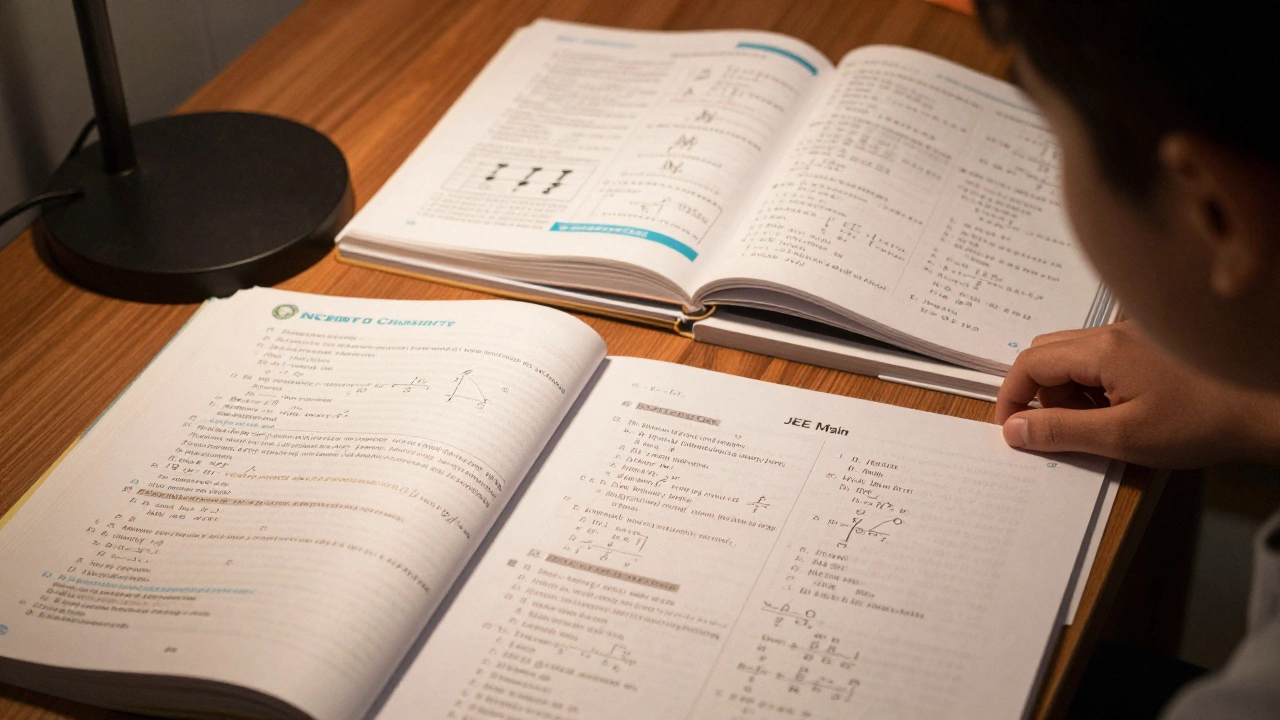
On paper, the syllabus for both exams looks identical. Both cover Physics, Chemistry, and Mathematics based on the Class 11 and 12 NCERT curriculum. However, the application of this syllabus differs drastically.
In JEE Main, questions often test direct application of formulas and standard concepts. If you know the formula for projectile motion, you can likely solve the problem. In JEE Advanced, the same topic might involve a scenario where air resistance is considered, or multiple projectiles interact, requiring you to derive solutions from first principles rather than plug-and-play.
Chemistry in JEE Main leans heavily on factual recall from NCERT books, especially for Inorganic Chemistry. In JEE Advanced, while NCERT is still foundational, Organic Chemistry mechanisms and Physical Chemistry calculations become significantly more intricate, often combining thermodynamics with kinetics in a single problem.
Mathematics sees the biggest shift. JEE Main Math is calculative and straightforward. JEE Advanced Math is abstract. Expect questions that combine calculus with algebra in ways that don’t immediately suggest a solution path. You aren’t just solving for x; you’re proving why a certain function behaves a specific way under given constraints.
Difficulty Curve: Why JEE Advanced Hurts More
Let’s talk about pain points. JEE Main is tough, but it’s predictable. The difficulty level remains relatively consistent across sessions. JEE Advanced is unpredictable. One year, Paper 1 might be heavily physics-based; the next, it could be math-heavy. The complexity isn’t just in the calculation; it’s in the interpretation.
A common mistake students make is assuming that high JEE Main preparation automatically translates to JEE Advanced success. It doesn’t. Many students who score 99+ percentile in JEE Main fail to qualify for JEE Advanced because they haven’t practiced the higher-order thinking skills required. JEE Advanced rewards those who can think outside the box, not just those who memorize the box.
For instance, a typical JEE Main question might ask you to calculate the center of mass of a simple system. A JEE Advanced question might ask you to analyze the motion of a variable-mass system where mass is being ejected continuously, requiring integration and differential equations.

Strategy: How to Prepare for Both Without Burning Out
Since JEE Main is the gateway to JEE Advanced, your preparation strategy must be phased. Here’s how smart candidates approach it:
- Months 1-8 (Foundation): Focus on NCERT textbooks for Chemistry and basic concepts for Physics and Math. Build a strong base. This benefits both exams.
- Months 9-12 (JEE Main Focus): Start solving previous years’ JEE Main papers. Work on speed and accuracy. Identify weak areas and fix them. Aim for a 95+ percentile target early.
- Post-JEE Main (If Qualified): Shift gears immediately. Stop doing routine JEE Main practice. Begin tackling JEE Advanced-level problems. Use reference books like HC Verma for Physics and Irodov for advanced problems if needed.
- Final Months: Take mock tests for JEE Advanced. Analyze mistakes deeply. Understand why you got a question wrong-was it a concept gap or a silly error?
Do not neglect JEE Main even if you are targeting IITs. A good JEE Main score gives you backup options (NITs/IIITs) and reduces pressure during JEE Advanced. Pressure kills performance.
Common Pitfalls to Avoid
Many students fall into traps that derail their preparation. Here are the most common ones:
- Ignoring NCERT: Especially for Chemistry, NCERT is the bible for JEE Main. Skipping it means losing easy marks.
- Over-specializing Too Early: Don’t spend weeks on advanced calculus before mastering basic trigonometry. Balance is key.
- Neglecting Mock Tests: Theory alone won’t help. You need to simulate exam conditions to build stamina and time management skills.
- Comparing Scores: Your friend’s JEE Main score doesn’t matter. Focus on your own improvement trajectory.
What Happens After the Exams?
Once the results are out, the process moves to counseling. For JEE Main, the Central Seat Allocation Board (CSAB) handles counseling for NITs and IIITs. For JEE Advanced, JoSAA (Joint Seat Allocation Authority) conducts counseling for IITs, NITs, and other institutions.
Your rank in JEE Advanced determines your IIT branch choice. Your JEE Main rank determines your NIT/IIIT choice. Interestingly, your JEE Advanced rank also contributes to your overall composite score for JoSAA counseling, weighted alongside your JEE Main score. So, performing well in both maximizes your chances of getting a preferred branch in a preferred institute.
Can I appear for JEE Advanced without taking JEE Main?
No. JEE Main is a mandatory prerequisite for JEE Advanced. You must qualify in JEE Main (top 250,000 ranks) to be eligible to register for JEE Advanced.
Is the syllabus for JEE Main and JEE Advanced exactly the same?
The topics covered are similar, based on Class 11 and 12 curricula. However, JEE Advanced delves much deeper into concepts and applies them in more complex, multi-step problems. JEE Main focuses on breadth and standard applications.
How many times can I attempt JEE Main and JEE Advanced?
You can attempt JEE Main twice in a year (Session 1 and Session 2). The best of the two scores is considered. JEE Advanced can be attempted only once per year, provided you qualify from JEE Main.
Which exam is harder: JEE Main or JEE Advanced?
JEE Advanced is significantly harder. It requires deeper conceptual understanding, faster problem-solving skills, and the ability to handle unconventional question formats. JEE Main is challenging but more straightforward.
Do I need to prepare differently for JEE Main and JEE Advanced?
Yes. While the foundation is the same, JEE Main preparation should focus on speed, accuracy, and NCERT coverage. JEE Advanced preparation requires solving complex, multi-concept problems and practicing advanced reference materials.