Best Competitive Exams After Graduation in 2026: A Complete Guide
 Aug, 4 2026
Career Path Decision Tool
Select the option that best describes you in each category below:
Recommended Career Paths
Standing at the crossroads of your career right after finishing your degree can feel overwhelming. You have a diploma in hand, but the job market is noisy, competitive, and often confusing. Many graduates ask themselves the same question: which path offers stability, growth, and respect? For millions of students, especially in India and other emerging economies, competitive exams are not just an option; they are the primary gateway to secure, high-paying careers.
The truth is, there is no single "best" exam for everyone. The right choice depends entirely on your academic background, your risk appetite, and your long-term professional goals. Are you looking for the prestige of a civil service role? Do you want the fast-paced environment of the corporate sector via management roles? Or do you prefer the security of a government bank position? Let’s break down the top competitive exams available in 2026, analyze their pros and cons, and help you decide which one aligns with your vision.
Understanding Your Academic Background First
Before diving into specific exams, we need to look at your undergraduate degree. This is the biggest filter. If you studied Engineering, Medical, or Commerce, your options differ significantly from those who studied Arts or Humanities. However, some exams are open to all graduates regardless of their major, while others require specific subjects.
For instance, if you have a background in Science or Engineering, you might lean towards technical services like the Indian Forest Service (IFoS) or public sector undertakings (PSUs). On the other hand, graduates from any stream-Arts, Science, Commerce, or Engineering-are eligible for the Union Public Service Commission (UPSC) Civil Services Examination. Understanding this eligibility matrix is crucial because it saves you months of wasted effort preparing for an exam you cannot sit for.
The Gold Standard: UPSC Civil Services Examination
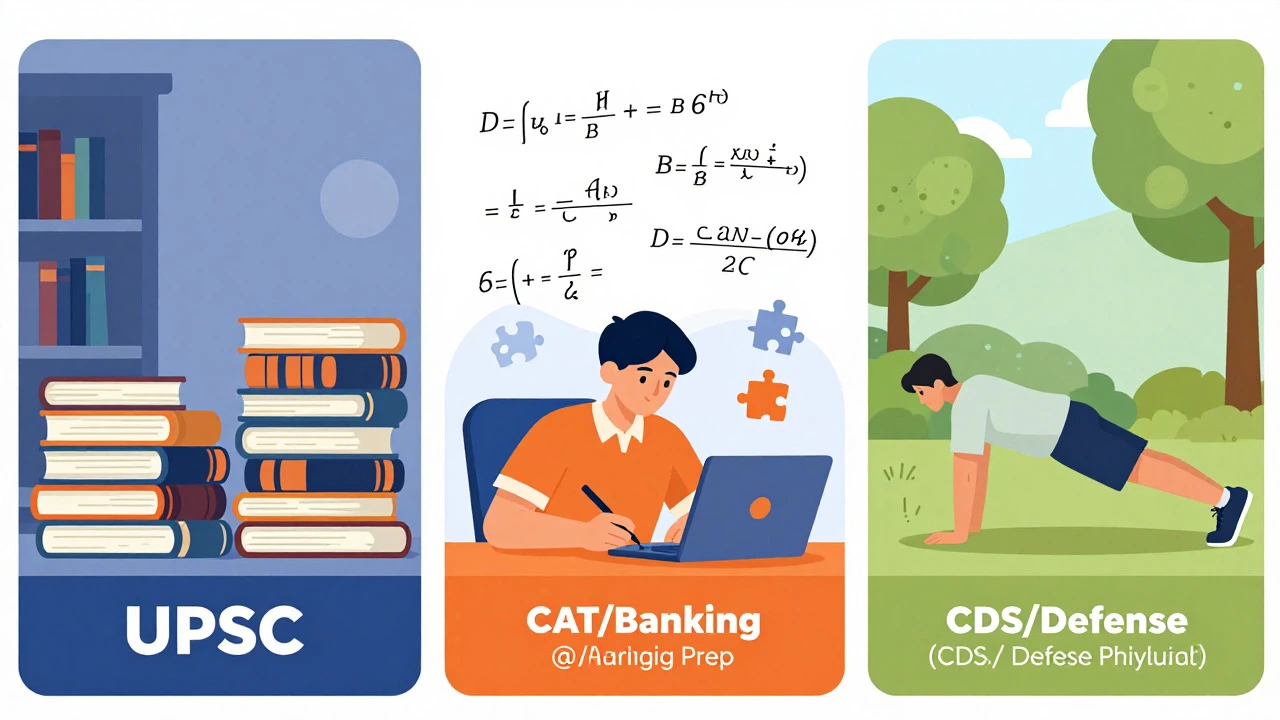
If you dream of power, policy-making, and societal impact, the UPSC CSE is the ultimate destination. It recruits candidates for roles such as Indian Administrative Service (IAS), Indian Police Service (IPS), and Indian Foreign Service (IFS). These positions offer unparalleled job security, social status, and a direct line to influencing national policies.
However, come with your eyes open. The selection ratio is less than 0.1%. It requires not just intelligence but immense perseverance. The syllabus is vast, covering history, geography, polity, economy, and current affairs. Most successful candidates spend two to three years preparing full-time. Is it worth it? If you have a burning desire to serve the nation and possess the mental fortitude to handle rejection, then yes. But if you need a quick job to support your family, this might not be the most practical first step.
Stability and Prestige: State PSC and SSC Exams
While UPSC is the national giant, State Public Service Commissions (PSCs) offer similar opportunities at the state level. Exams like UPPSC, BPSC, and TNPSC recruit officials for state administration, police, and revenue departments. These exams are often considered slightly easier than UPSC because the competition is localized, though the syllabus overlaps significantly.
Another major player is the Staff Selection Commission (SSC). The SSC Combined Graduate Level (CGL) exam recruits for Group B and Group C posts in various ministries and organizations across the government. Roles include Inspector of Income Tax, Auditor, and Sub-Inspector. These jobs offer great work-life balance compared to field postings in IAS/IPS and provide a solid middle-class lifestyle with excellent perks. For many graduates, SSC CGL is the sweet spot between difficulty and reward.
The Corporate Gateway: CAT and Management Quotas
Not every graduate wants to wear a khaki uniform or sit in a government office. If you are drawn to the corporate world, marketing, finance, or entrepreneurship, the Common Admission Test (CAT) is your ticket. An MBA from a top-tier institute like the IIMs can skyrocket your salary potential. Fresh graduates from top IIMs often start with packages exceeding ₹20-30 lakhs per annum.
But here is the catch: the cost. Top MBA programs are expensive, ranging from ₹20 lakhs to ₹30 lakhs in tuition fees. While the return on investment is high, it is not guaranteed. You need strong academics, diverse extracurriculars, and interview skills to crack these colleges. Unlike government exams where marks determine everything, management admissions involve a holistic profile review. If you enjoy numbers, strategy, and people management, CAT is a powerful alternative to traditional government exams.
Financial Security: Banking Exams (IBPS and SBI)
Banking jobs remain one of the most sought-after sectors for graduates due to their structured career paths and financial benefits. The Institute of Banking Personnel Selection (IBPS) conducts the Probationary Officer (PO) exam for 11 public sector banks, while the State Bank of India (SBI) conducts its own separate PO and Clerk exams.
Why do so many choose banking? First, the preparation time is relatively short-usually 3 to 6 months of focused study. Second, the syllabus is manageable: Quantitative Aptitude, Reasoning, English Language, and General Awareness. Third, the jobs are stable, with clear promotion cycles and good perks like housing allowances and medical benefits. For graduates seeking immediate employment without the multi-year grind of UPSC, banking exams offer a pragmatic and rewarding route.
Defense Services: NDA and CDS
If you have a spirit of adventure and discipline, consider the armed forces. The National Defence Academy (NDA) is typically taken after 12th grade, but the Combined Defence Services (CDS) exam is open to graduates. It recruits officers for the Indian Army, Navy, and Air Force.
The CDS exam tests English, General Knowledge, and Elementary Mathematics (for Army entry). Beyond the written test, you must pass rigorous physical fitness tests and a medical examination. Life in the defense forces is unique; it offers unmatched camaraderie, travel opportunities, and a sense of duty that civilian jobs rarely match. However, it requires sacrificing personal freedom and dealing with frequent transfers and deployment risks. It is a calling, not just a career.
Teaching and Research: CTET and NET/JRF
For those who love academia, the Central Teacher Eligibility Test (CTET) and the National Eligibility Test (NET) are critical. CTET qualifies you to teach in central government schools, while UGC-NET is essential for becoming a lecturer in universities or pursuing a Junior Research Fellowship (JRF).
The education sector is undergoing significant reforms in 2026, with increased focus on quality teaching and research. If you are passionate about mentoring the next generation or contributing to scientific knowledge, these exams open doors to respected academic positions. The work-life balance in teaching is generally better than in banking or civil services, allowing more time for personal pursuits.

Comparison Table: Choosing Your Path
| Exam Name | Conducting Body | Preparation Time | Difficulty Level | Career Outcome |
|---|---|---|---|---|
| UPSC CSE | Union Public Service Commission | 2-3 Years | Very High | IAS, IPS, IFS Officers |
| SSC CGL | Staff Selection Commission | 6-12 Months | Moderate | Government Clerical/Inspector Roles |
| IBPS PO/SBI PO | Institute of Banking Personnel Selection / SBI | 3-6 Months | Moderate | Bank Manager/Officer |
| CAT | IIMs Consortium | 6-12 Months | High (Academic) | MBA from Top B-Schools |
| CDS | UPSC | 6-9 Months | High (Physical + Mental) | Army/Navy/Air Force Officer |
| UGC-NET | National Testing Agency (NTA) | 6-12 Months | Moderate to High | Lecturer/Research Fellow |
How to Decide: A Practical Framework
Choosing the wrong exam can lead to burnout and regret. Here is a simple framework to help you decide:
- Assess Your Risk Tolerance: Can you afford to fail multiple times? If yes, go for UPSC or CAT. If you need a job soon, target Banking or SSC.
- Evaluate Your Strengths: Are you good at memorizing facts and writing essays? UPSC is your game. Do you excel in math and logic? Banking or CAT might suit you better. Are you physically fit? Consider CDS.
- Consider Financial Constraints: Government exams are free or low-cost. MBA programs are expensive. If funding is an issue, prioritize government jobs or scholarships.
- Define Your Lifestyle Goals: Do you want a settled life in your hometown? State PSCs are ideal. Do you want to travel and face challenges? Defense or Foreign Service is the way.
Common Pitfalls to Avoid
Many graduates make the mistake of preparing for multiple exams simultaneously without a clear strategy. This leads to superficial preparation and poor results. Instead, pick one primary goal and one backup plan. For example, prepare for UPSC as your main goal, but keep SSC CGL as a backup since the general knowledge portion overlaps.
Another common error is ignoring current affairs. Whether it is UPSC, Banking, or SSC, current events form a significant part of the syllabus. Start reading a reputable newspaper daily. Don't rely solely on coaching materials; develop your own analysis of news events.
Finally, don't underestimate the importance of mock tests. Theory is useless if you cannot manage time during the actual exam. Take regular mock tests to identify weak areas and improve speed and accuracy. Analyze every mistake you make in practice tests-it is the fastest way to learn.
Next Steps for Aspiring Candidates
Once you have chosen your exam, create a realistic study schedule. Break down the syllabus into weekly targets. Join a community of aspirants online or offline to stay motivated and share resources. Stay consistent, even when progress feels slow. Remember, success in competitive exams is a marathon, not a sprint. With the right mindset and disciplined approach, you can secure a bright future in 2026 and beyond.
Which is the easiest competitive exam after graduation?
The concept of "easiest" is subjective, but generally, exams like SSC CHSL or Railway RRB NTPC are considered less difficult than UPSC or CAT because the syllabus is narrower and the competition is lower relative to the number of vacancies. However, "easy" does not mean "guaranteed." Thousands still compete for these seats, so serious preparation is always required.
Can I appear for UPSC after any graduation?
Yes, UPSC CSE is open to graduates from any discipline-Arts, Science, Commerce, Engineering, Medicine, etc. You do not need a specific major. However, having a relevant optional subject in your postgraduate studies can sometimes give you an edge in the mains examination.
Is it better to prepare for Banking or SSC?
It depends on your strengths. If you are strong in quantitative aptitude and reasoning, Banking exams (IBPS/SBI) might be easier to crack quickly. If you are good at general knowledge and English, SSC CGL could be a better fit. Many candidates prepare for both since the preliminary stages overlap significantly.
How much time should I dedicate to daily preparation?
For full-time aspirants, 8-10 hours of focused study is recommended. For working professionals or students, 4-6 hours of quality study can be sufficient if utilized efficiently. Consistency matters more than the number of hours. Ensure you take breaks to avoid burnout.
Do I need coaching for competitive exams?
Coaching is not mandatory. Many toppers are self-taught using books, online resources, and previous year papers. However, coaching provides structure, peer competition, and expert guidance, which can be helpful if you struggle with self-discipline or lack access to quality study material.
What is the age limit for most competitive exams?
Most exams like UPSC, SSC, and Banking have an upper age limit of around 30-32 years for general category candidates, with relaxations for reserved categories. Always check the official notification for the specific exam, as age limits can change slightly each year.
Can I prepare for multiple exams simultaneously?
Yes, you can prepare for exams with overlapping syllabi, such as UPSC Prelims and State PSCs, or SSC CGL and Banking Prelims. However, avoid mixing exams with vastly different requirements, like UPSC (essay-heavy) and CAT (quantitative-heavy), unless you have exceptional time management skills.